Anybody who has watched many movies or television shows has seen them—the ubiquitous silver suits worn by pilots as they explore the unknown. They are called pressure suits, and one can trace their lineage to Wiley Post or, perhaps, a bit earlier.
There are two kinds of pressure suits: partial pressure and full pressure. David Clark, the man, once pointed out that these were not very good names, but they are the ones that stuck. In a partial-pressure suit, the counter-pressure is not as complete as in a full-pressure suit, but it is placed so that shifts in body fluids are kept within reasonable limits. On the other hand, a full-pressure suit, which is an anthropomorphic pressure vessel, creates an artificial environment for the pilot.
One type of pressure suit is not necessarily “better” than the other, and both partial pressure and full pressure suits are still in limited use around the world. Both type of suits have benefits and limitations and, by and large, pilots dislike both, even while acknowledging their necessity. For the past 60 years, they have been an indispensible part of a small fragment of the aviation world.
Although space suits, which differ from pressure suits in subtle, but important ways, have been well covered in literature, pressure suits have gone unheralded except as introductions to the space suit histories. This e-book is an attempt to correct that, and covers pressure suits from the beginning through the end of the Space Shuttle Program.
NASA has published a colorful, picture-filled book that details the development and use of this protective clothing worn by test pilots, astronauts and others as they soar high above Earth.
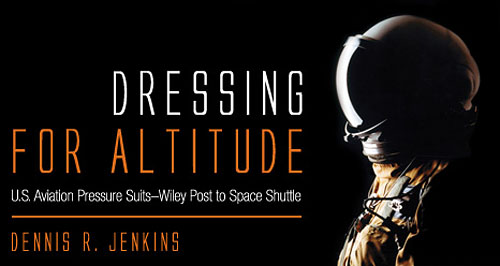
“Dressing for Altitude: U.S. Aviation Pressure Suits — Wiley Post to Space Shuttle” provides a 526-page survey of the partial- and full-pressure suits designed to keep humans alive at the edge of space since their first use during the years before World War II. Pressure suits are not the spacesuits worn by spacewalking astronauts.
The book explores the challenges the clothiers-turned-engineers faced in designing a garment that could be relatively lightweight, flexible, inflatable, and still keep an ejecting pilot safe at high altitude and in the water.
“This work is designed to provide the history of the technology and explore the lessons learned through the years of research in creating, testing, and utilizing today’s high-altitude suits,” said Tony Springer of NASA’s Aeronautics Research Mission Directorate at the agency’s headquarters in Washington.
Dennis R. Jenkins, a writer, engineer and manager with 30 years of experience working on NASA programs, including the space shuttle, wrote the book and assembled its photographs and illustrations. Jenkins said he became interested in the topic especially after studying the work and dedication of Goodrich and David Clark Company, the two major companies responsible for most of the pressure suit’s development through the years.
“I knew little about pressure suits going into the book, so the entire process was a learning exercise to me,” Jenkins said.
Order printed copies of the coffee-table-style book from NASA’s Information Center.
Download an e-book version of the book in PDF format at no charge.
There’s also a version available for Kindle, but that version isn’t free.
More information about aeronautics research at NASA.
Filed under: Announcements