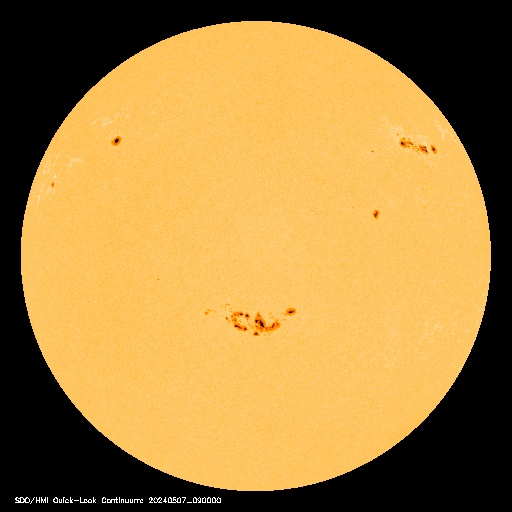
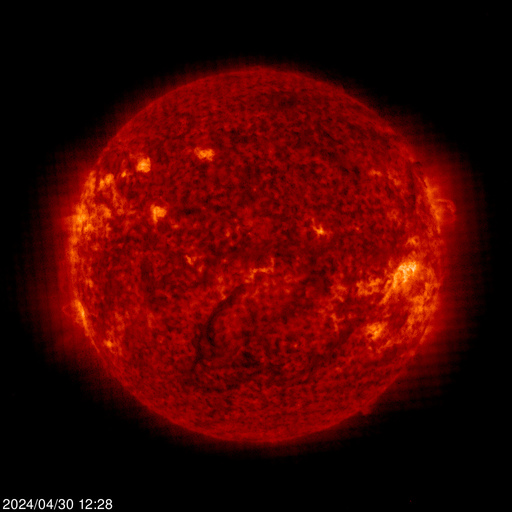
One of the largest sunspots in years, AR1944, has turned toward Earth and it is crackling with strong flares. On Jan. 7th (yesterday), the active region produced M7- and X1-class eruptions, and more appear to be in the offing. As this alert was being issued, analysts were waiting for more data from solar observatories to clarify the possibility of CME impacts and geomagnetic storms in the days ahead.
AR1944 is one of the biggest sunspots of the past decade. The sprawling active region is more than 200,000 km wide and contains dozens of dark cores. Its primary core, all by itself, is large enough to swallow Earth three times over. To set the scale of the behemoth, Karzaman Ahmad inserted a picture of Earth in the corner of the picture above that he took on Jan. 7th from the Langkawi National Observatory in Malaysia.
On the BBC’s Stargazing Live event, reported Liz Bonnin was sent north to Tromso in Norway to see if she and her camera team could broadcast an aurora live – in real time – using a new type of camera. Half an hour before broadcast, the clouds on an otherwise overcast day, parted and revealed a green curtain of light traversing the sky from horizon to horizon. So this task was a complete success. I guess we have AR1944 to thank for that!
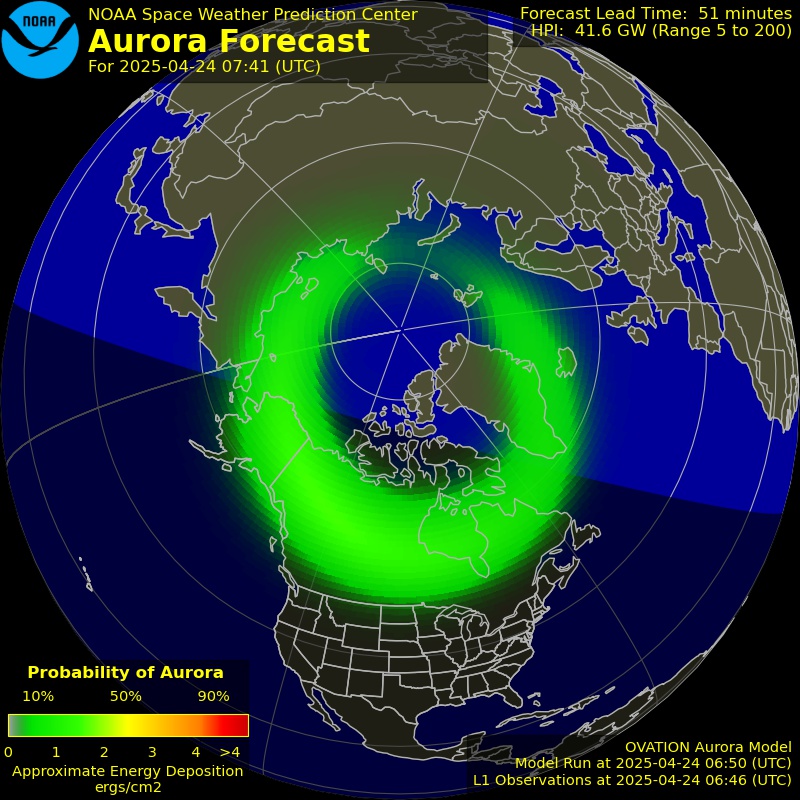
High-latitude sky watchers should be alert for auroras on Jan. 9th when the cloud is expected to arrive. NOAA forecasters estimate a 60% chance of polar geomagnetic storms.
The X1-flare that hurled the CME toward Earth also accelerated a swarm of high-energy protons in our direction. Effects of the proton fusillade are visible in this Jan. 7th coronagraph movie from the Solar and Heliospheric Observatory (SOHO):
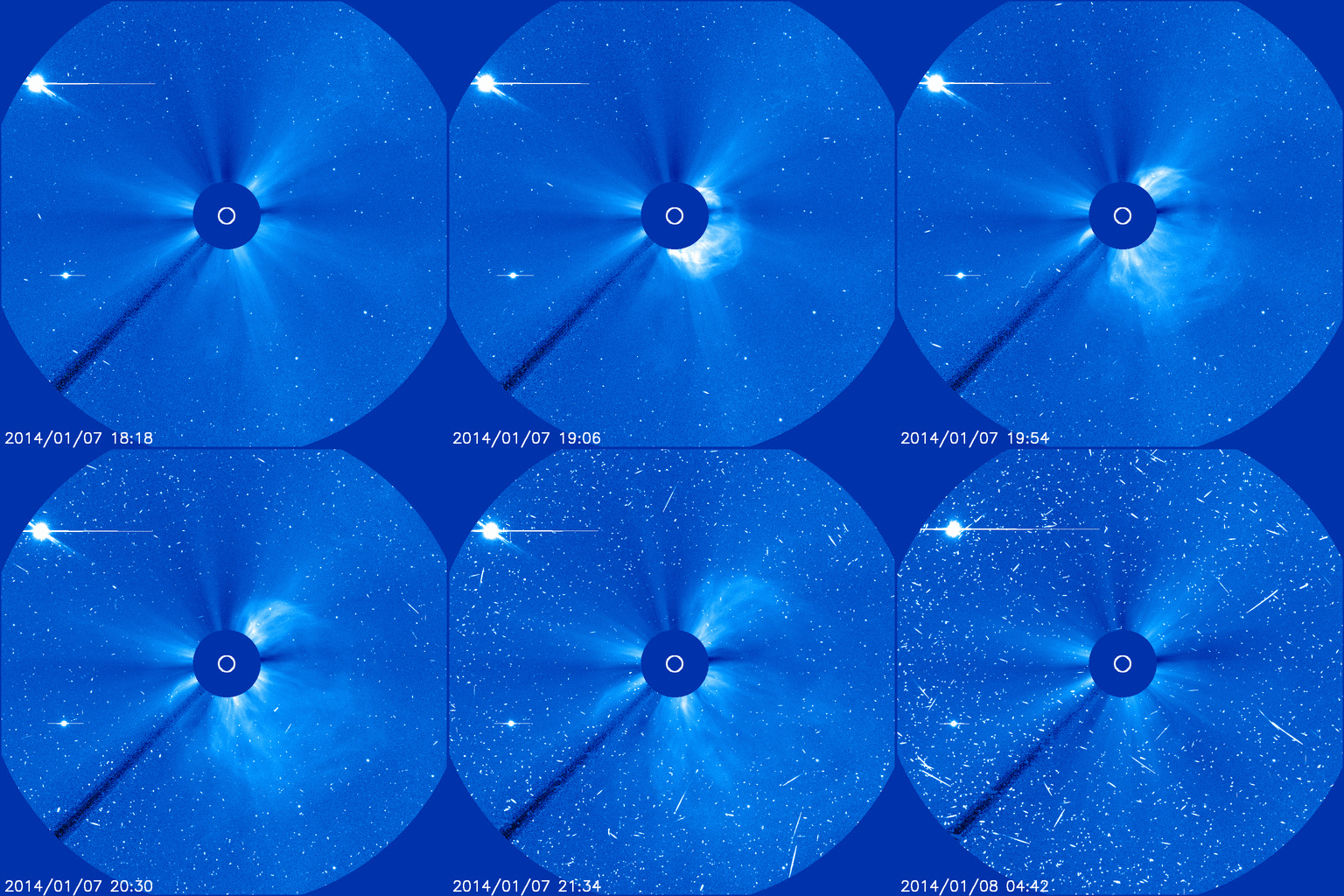
The “snow” in this movie is caused by solar protons striking the spacecraft’s CCD camera. A veritable blizzard of speckles develops as the CME emerges into full view. Indeed, many of the protons are accelerated by shock waves at the forefront of the expanding cloud.
This ongoing radiation storm ranks S2 on NOAA storm scales. It is rich in “hard” protons with more than 100 MeV of energy, which accounts for the snowiness of the SOHO coronagraph images. According to NOAA, “passengers and crew in high-flying aircraft at high latitudes may be exposed to elevated radiation risk” during such a storm.
The sunspot has an unstable ‘beta-gamma-delta’ magnetic field that is likely to erupt again today. NOAA forecasters estimate an 80% chance of M-class flares and a 50% chance of X-flares.
Have something to add to this story? Share it in the comments.
<?php
if (!function_exists("display_footer")) { include("nso/article_footer.php"); }
display_footer("solar telescope,solar filter", "74927 74922", "Solar M-Class Flares", "Solar Storm”, “”, “1”);
?>
Filed under: The Sun