One of the best meteor showers of the year – the Perseids – will hit their peak tonight (August 11/12). And even if you’re clouded out, suffer from light polution or are surrounded by city lights, you can still have a front row seat. This weekend, NASA are streaming its first Perseid webcast.
The camera activates at full dusk (approx. 9 p.m. EDT). During the day you will either see a dark gray box or pre-recorded footage.
Meteor rates can get as high as 100 per hour, with many fireballs visible in the night sky. Early in the evening, a waxing crescent moon will interfere slightly with this year’s show, but it will have set by the time of the best viewing, just before dawn. The best opportunity to see Perseids is during the dark, pre-dawn hours of Aug. 12 (tomorrow morning).
How To See Perseid Meteors
For best views, find an open sky because Perseid meteors come across the sky from all directions. Lie on the ground and look straight up into the dark sky. Again, it is important to be far away from artificial lights. Your eyes can take up to 30 minutes to adapt to the darkness, so allow plenty of time for your eyes to dark-adapt.

The Perseids Radiant
What Are The Perseids?
The Perseids have been observed for at least 2,000 years and are associated with the comet Swift-Tuttle, which orbits the sun once every 133 years. Each year in August, the Earth passes through a cloud of the comet’s debris. These bits of ice and dust – most over 1,000 years old – burn up in the Earth’s atmosphere to create one of the best meteor showers of the year. The Perseids can be seen all over the sky, but the best viewing opportunities will be across the northern hemisphere. Those with sharp eyes will see that the meteors radiate from the direction of the constellation Perseus.
What’s Happening So Far
The Perseid meteor shower is intensifying as Earth moves deeper into the debris stream of parent comet 109P/Swift-Tuttle. International observers are reporting as many as 30 Perseids per hour from dark sky sites.
NASA’s All-Sky Fireball Network has recorded more than a dozen Perseid fireballs in the past few nights. Many more are expected.
Photographing Meteors
Meteor photography can be accomplished with most SLR cameras, including old 35MM film and digital SLR cameras. You will need to use the Bulb setting on the camera to take long exposures (up to 30s) or a cable release.
Put your camera into Manual Mode so that you have full control over aperture, shutter speed and ISO. Open your lens fully so it’s capturing as much light as possible. Manually focus the lens on the stars. Use the Bulb setting or a cable release to take exposures between 10 and 30 seconds. Set a high ISO – 400 to 1600; the higher the ISO, the shorter the exposures need to be but you’ll pick up fainter meteors. The trade-off is that your images will be more grainy.
Capturing a meteor with a camera is not as easily accomplished a task as you might think. The best meteor photos are made under the best conditions and with good equipment.
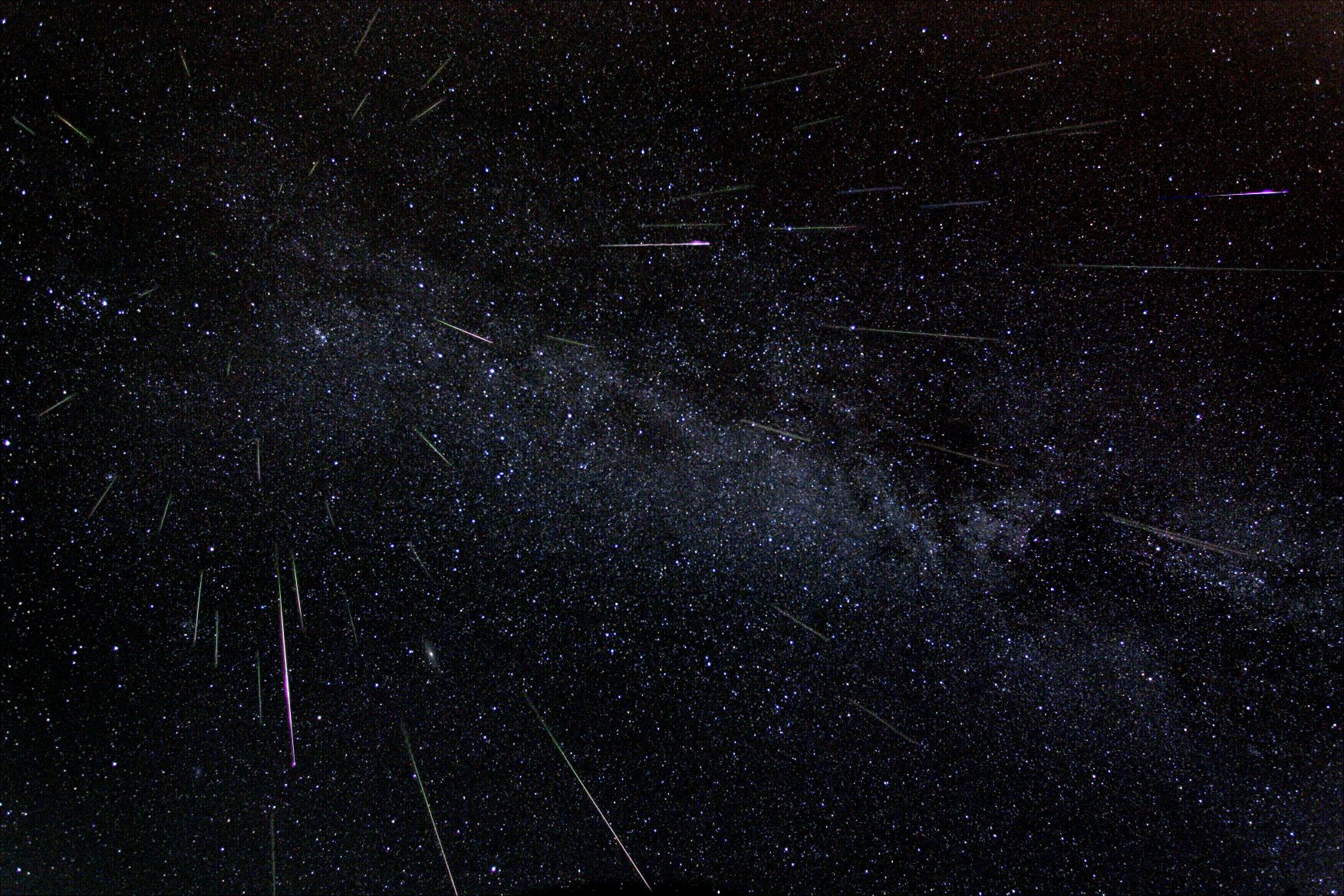
astronomer Fred Bruenjes recorded a series of many 30 second long exposures spanning about six hours on the night of 2004 August 11/12 using a wide angle lens. Combining those frames which captured meteor flashes, he produced this dramatic view of the Perseids. Bruenjes notes that there are 51 Perseid meteors in the composite image, including one seen nearly head-on.
You need to be at a dark site, away from city, street and security lights. The more light pollution in the sky, even from a city miles away, the harder it is to catch a meteor. The more light pollution there is, the shorter your exposures need to be (before the sky becomes too bright) and the less chance you have of capturing a meteor.
Point your camera away from the shower’s radiant. If you point the camera at the radiant, you’ll get meteors that approach head-on so you’re much less likely to capture meteor trails.
In exposures more than about 15 seconds long, stars will start to trail. When this happens depends on the focal length of a lens. The shorter the lens, the longer you can exposure before seeing stars trails. The trails occur because the Earth is rotating against the background stars.
Don’t use a telephoto lens. These lenses provide a magnified view of a smaller area of sky. Since you don’t know where meteors will appear, you want to cover as much sky as possible, so use a 50mm or 28mm lens instead.
Mount your camera on something solid like a tripod. Hand-holding a camera is out of the question – you’ll just end up with a picture that shows how unsteady your hands are over 10-30 seconds!
Experiment with your lenses, exposures and ISO settings. You have all night (weather permitting, job next day permitting) to take photos, see the results and try to improve on them.
Send in any photos of meteors you to take and I’ll publish them here.
Filed under: Meteors & Meteorites