The tiny dot against the streaking star field in the image below is one of the last views that ground-based observers will see of ESA’s iconic Herschel space observatory.
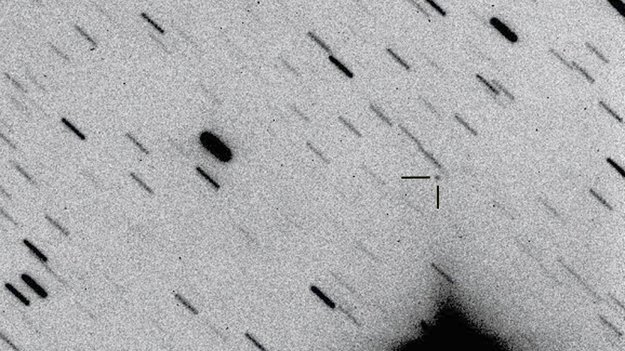
The Herschel space observatory is shown here in monochrome and negative against a backdrop of stars, the latter streaked by the telescope tracking the motion of the observatory as it drifts away from its position at Lagrange Point 2 into orbit around the Sun. The image was taken on 27 June 2013 with the 2 m Faulkes Telescope North on Haleakala, Hawaii using a Bessel R’ band filter, and is a combination of seven 120-second exposures. The Faulkes Telescopes are operated by the Las Cumbres Observatory Global Telescope Network. Image credit: N. Howes/E. Guido/Faulkes Telescope/LCOGT
Herschel spent over three years taking stunning images of the Universe in far infrared wavelengths, but in April the spacecraft depleted the last of its helium coolant, concluding science operations.
After this, the spacecraft operations team performed a series of engineering tests. A series of thruster burns moved it from its orbit around the L2 point 1.5 million kilometres from the Earth, and into a heliocentric orbit. Finally, in June, the spacecraft was switched off.
As well as being tracked by ESA ground stations throughout its mission, amateur astronomers have also enjoyed spotting the spacecraft.
Last week, as Herschel began moving away from Earth, astronomers Nick Howes and Ernesto Guido from the Remanzacco Observatory used the 2m diameter Faulkes Telescope North in Hawaii to image the spacecraft.
The observation was a particular challenge as the final manoeuvres made by the ESA flight control team resulted in the observatory being at a slightly different position on the sky compared to that predicted by existing orbital data.
But the imaging campaign was successful, as seen in the image presented here, with Herschel indicated by the two lines to the right of centre. Stars appear as streaks because the astronomers were tracking the motion of Herschel through the sky.
Herschel’s new orbit will send it around the Sun, coming back into Earth’s neighbourhood around 13 years from now.
Determining an accurate orbit now is important, because its increasing distance will make it fainter and much harder to keep track of in the intervening years.
Filed under: Space Telescopes