The Veil Nebula

Discovered on 5 September 1784 by astronomer William Herschel, the Veil Nebula was once a star. Now it is a twisted mass of shock waves that appears six times larger than the full Moon in the sky.

This Hubble Space Telescope image shows just a small part of the nebula, a region known as the ‘south-eastern knot’. The entire nebula …

Read the rest of this article
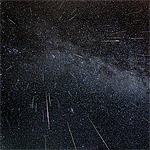
One of the best meteor showers of the year – the Perseids – will hit their peak tonight (August 11/12). And even if you’re clouded out, suffer from light polution or are surrounded by city lights, you can still have a front row seat. This weekend, NASA are streaming its first Perseid webcast.

The camera activates at full dusk (approx. …

Read the rest of this article

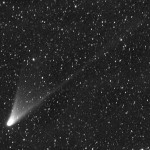
Comet Pan-STARRS (C/2011 L4) is now inside the orbit of Mercury and it is brightening as it approaches the sun. Observers in the southern hemisphere say the comet can be seen with the naked eye even through city lights. Currently, it is about as bright as the stars of the Big Dipper (Ursa Major) (magnitude +2 to +3). The comet …

Read the rest of this article

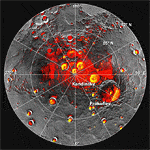
NASA has recently discovered a very strange planet. Its days are twice as long as its years. It has a tail like a comet. It is hot enough to melt lead, yet capped by deposits of ice. And to top it all off … it appears to be pink.

The planet is Mercury.

Of course, astronomers have known about Mercury …

Read the rest of this article
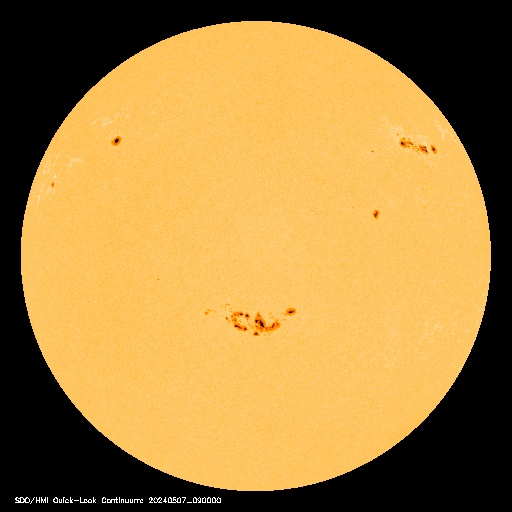
Far beyond the orbits of Neptune and Pluto, where the sun is a pinprick of light not much brighter than other stars, a vast swarm of icy bodies circles the solar system. Astronomers call it the “Oort Cloud,” and it is the source of some of history’s finest comets.

One of them could be heading our way now.


A comet …

Read the rest of this article
The Perseids are the best-known of the year’s meteor showers, and are usually the most popular as the nights do not get as cold as the other major showers in the winter.


The Perseid meteor shower is underway. There’s more to see than meteors, however, when the shower peaks on August 11th through 13th. The brightest planets in the solar …

Read the rest of this article
Note to sky watchers: Put on your winter coats. What you’re about to read might make you feel an uncontrollable urge to dash outside.

The brightest planets in the solar system are lining up in the evening sky, and you can see the formation – some of it at least – tonight.

Go out at sunset and look west. Venus …

Read the rest of this article
T’was the Night after Christmas and all through the house, not a creature was stirring …

…because everyone was outside watching the planets align?

It’s true. On Dec. 26th, the night after Christmas, Venus and the slender crescent Moon will gather for a jaw-dropping conjunction in the western sky.

The action begins shortly before sunset. Around 4:30 pm to 5:00 …

Read the rest of this article

Astronomers are predicting a dazzling display of shooting stars on the night of August 12/13 as the Perseid meteor shower reaches a peak in activity.

The show begins at sunset when Venus, Saturn, Mars and the crescent Moon pop out of the western twilight in tight conjunction. All four heavenly objects will fit within a circle about 10 degrees in …

Read the rest of this article

When the sun goes down tonight, step outside and look south. Beaming through the twilight is one of the prettiest things you’ll ever see – a tight three-way conjunction of Venus, Jupiter and the crescent Moon. The event is visible from all parts of the world, even from light-polluted cities.

People in New York and Hong Kong will …

Read the rest of this article