The Topography of Ceres

Occator Crater on Ceres is home to the brightest area on the entire dwarf planet.

At 57 miles (92 kilometers) wide and 2.5 miles (4 kilometers) deep, Occator displays evidence of recent geologic activity.

NASA’s Dawn mission found that the bright spots may have been produced by upwelling of salt-rich liquids after the impact that formed the crater.

Pan and …

Read the rest of this article

Asteroid Threat

NASA is hunting for Near-Earth Objects, while also working on ways to defend Earth against them.…

Read the rest of this article

Asteroid Day Live

June 30 has been declared by the United Nations to be International Asteroid Day.

To celebrate the day, there will be a 24-hour global telethon with scientists, astronauts space agencies and even rock stars taking part.

The Asteroid Day Live Stream event will be broadcast worldwide from Luxembourg as well as online and will highlight the threat posed to our …

Read the rest of this article

Asteroid Day

ESA is participating in today’s international Asteroid Day, to mark the largest observed asteroid strike in recorded history – the 1908 airburst above Tunguska in Siberia. The Agency monitors asteroids as well as performs scientific research, not to mention contingency planning: what could be done if an asteroid were incoming?

The Tunguska impact felled around 60 million trees across …

Read the rest of this article

Asteroid Day

Asteroid Day is an annual global movement to increase public awareness of potential asteroid impacts with Earth, and the importance of guarding against them. It was co-founded in 2015 by Brian May, astrophysicist and lead guitarist for the rock band Queen, Apollo astronaut Rusty Schweickart, and German filmmaker Grig Richters.

The following people spoke at the Tuesday, 9 February press …

Read the rest of this article

Probe Will Assist Agency in Search for Candidates to Explore

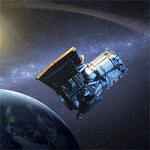
NASA’s Near-Earth Object Wide-field Infrared Survey Explorer (NEOWISE), a spacecraft that made the most comprehensive survey to date of asteroids and comets, has returned its first set of test images in preparation for a renewed mission.

NEOWISE discovered more than 34,000 asteroids and characterized 158,000 throughout the solar system during …

Read the rest of this article

Watch the NASA TV coverage of the asteroid redirection systems session of the NASA-hosted public workshop at the Lunar and Planetary Institute in Houston to examine 96 of the ideas submitted to the recent Request For Information on ways to accomplish the agency’s asteroid initiative.…

Read the rest of this article


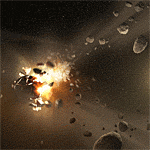
This artist’s conception shows how families of asteroids are created. Over the history of our solar system, catastrophic collisions between asteroids located in the belt between Mars and Jupiter have formed families of objects on similar orbits around the sun. Image credit: NASA/JPL-Caltech

Data from NASA’s Wide-field Infrared Survey Explorer (WISE) have led to a new and improved family tree …

Read the rest of this article


NASA is tracking a large near-Earth asteroid as it passes by the Earth-Moon system on May 31st. Amateur astronomers in the northern hemisphere may be able to see the space rock for themselves during the 1st week of June.

Here we go again. Another asteroid is paying a visit to the Earth-Moon system.

Asteroids have been a hot topic since …

Read the rest of this article

Comets visible to the naked eye are a rare delicacy in the celestial smorgasbord of objects in the nighttime sky. Scientists estimate that the opportunity to see one of these icy dirtballs advertising their cosmic presence so brilliantly they can be seen without the aid of a telescope or binoculars happens only once every five to 10 years. That said, …

Read the rest of this article