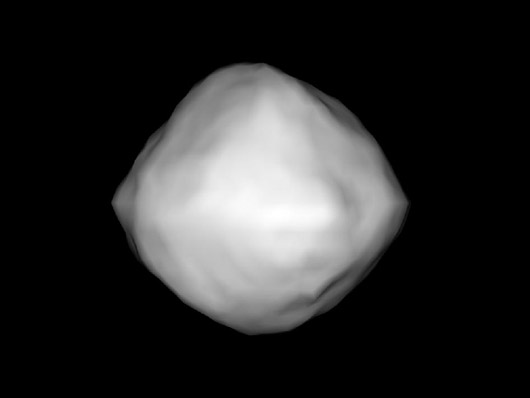
Watch live this weekend as an asteroid the size of a city block flies past the Earth.


Asteroid 4179 Toutatis passed by the Earth in 2004. Credit: ESO

On Sunday, July 22, there will have a live feed from the Slooh Space Camera. The show will start at 4:30 p.m. Pacific (7:30 p.m. Eastern) with images from the Slooh …

Read the rest of this article

Here’s the latest update from Planetary Resources on what’s happening with their asteroid mining plans:

Yesterday Eric Anderson was at the Farnborough Air Show with Richard Branson (more news on Branson in the future) announcing that Planetary had put down a deposit and signed up as one of the Virgin Galactic’s LauncherOne early launch customers. LauncherOne uses the WhiteKnightTwo carrier …

Read the rest of this article

Progress continues with Planetary Resources, the private syndicate that proposes to mine asteroids in the near future for rare metals. Here’s their latest communication:

We’ve been working our tails off at Planetary Resources planning our initial launches of our first spacecraft.

We call these first Asteroid finding spacecraft Arkyd Series-100 (next email we’ll tell you where the name ‘Arkyd’ comes …

Read the rest of this article

Researchers anticipate that asteroid 2011 AG5, discovered in January 2011, will fly safely past and not impact Earth in 2040.

Current findings and analysis data were reported at a May 29 workshop at NASA’s Goddard Space Flight Center in Greenbelt, Md., attended by scientists and engineers from around the world. Discussions focused on observations of potentially hazardous asteroids (PHAs).


Orbit …

Read the rest of this article

Just received this statement from Planetary Resources about what’s been happening since they announced the formation of their company a few weeks ago, so things are progressing:

If you’re like us, you’ve always had a life-long dream to open the space frontier.

We’re not just talking about taking a few people into orbit, but opening the resources of space, to …

Read the rest of this article

A scientist at NASA’s Jet Propulsion Laboratory in Pasadena, Calif., has accurately determined the mass of a nearby asteroid from millions of miles away. The celestial equivalent of “guess your weight” was achieved by Steve Chesley of JPL’s Near-Earth Object Program Office by utilizing data from three NASA assets – the Goldstone Solar System Radar in the California desert, the …

Read the rest of this article

A partnership with the UK’s Faulkes Telescope Project promises to boost the Agency’s space hazards research while helping students to discover potentially dangerous space rocks.


2m Faulkes North Telescope at Haleakalā, Hawaii, USA. Credits: Faulkes Telescope Project

ESA’s Space Situational Awareness (SSA) programme is keeping watch over space hazards, including disruptive space weather, debris objects in Earth orbit and asteroids …

Read the rest of this article

NASA’s Dawn spacecraft has provided researchers with the first orbital analysis of the giant asteroid Vesta, yielding new insights into its creation and kinship with terrestrial planets and Earth’s moon.


This image, made from data obtained by NASA’s Dawn spacecraft, shows the mineral distribution in the southern hemisphere of the giant asteroid Vesta. The mineral data came from Dawn’s visible …

Read the rest of this article

Research by NASA and international scientists concludes giant asteroids, similar or larger than the one believed to have killed the dinosaurs, hit Earth billions of years ago with more frequency than previously thought.

To cause the dinosaur extinction, the killer asteroid that impacted Earth 65 million years ago would have been almost 6 miles (10 kilometers) in diameter. By studying …

Read the rest of this article

Findings from NASA’s Dawn spacecraft reveal new details about the giant asteroid Vesta, including its varied surface composition, sharp temperature changes and clues to its internal structure. The findings were presented today at the European Geosciences Union meeting in Vienna, Austria and will help scientists better understand the early solar system and processes that dominated its formation.


These composite images …

Read the rest of this article