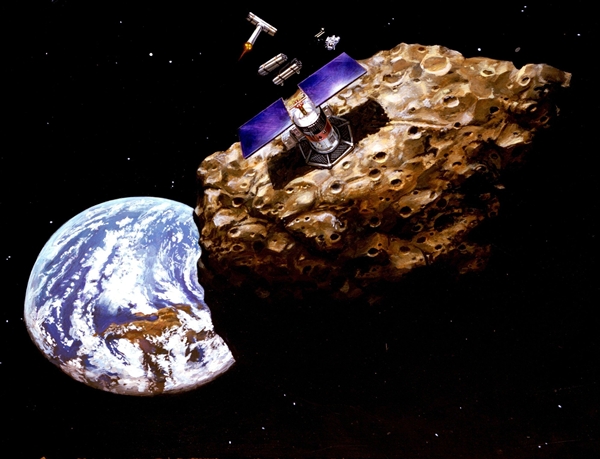
Seattle, Wash. – April 24, 2012 — Planetary Resources, Inc. announced today its plan to mine Near-Earth Asteroids (NEAs) for raw materials, ranging from water to precious metals. Through the development of cost-effective exploration technologies, the company is poised to initiate prospecting missions targeting resource-rich asteroids that are easily accessible.

Resource extraction from asteroids will deliver multiple benefits to humanity …

Read the rest of this article

Following on from my post a couple of days ago about how a number of Tech Billionaires and high-flyers have gotten together to create a private space program, I came across this article which provides a lot more detail about their plans…

There’s gold in them there hills. You know, those ones floating around in space. Asteroids contain many tons …

Read the rest of this article

NASA’s Dawn spacecraft has revealed unexpected details on the surface of the giant asteroid Vesta. New images and data highlight the diversity of Vesta’s surface and reveal unusual geologic features, some of which were never previously seen on asteroids.


In this image from NASA’s Dawn spacecraft, bright material extends out from the crater Canuleia on Vesta. The bright material appears …

Read the rest of this article

NASA’s Dawn spacecraft spent the last four years voyaging to asteroid Vesta – and may have found a planet.

Vesta was discovered over two hundred years ago but, until Dawn, has been seen only as an indistinct blur and considered little more than a large, rocky body. Now the spacecraft’s instruments are revealing the true complexity of this ancient world.…

Read the rest of this article

Vesta appears in a splendid rainbow-colored palette in new images obtained by NASA’s Dawn spacecraft. The colors, assigned by scientists to show different rock or mineral types, reveal Vesta to be a world of many varied, well-separated layers and ingredients. Vesta is unique among asteroids visited by spacecraft to date in having such wide variation, supporting the notion that it …

Read the rest of this article

NASA’s Deep Space Network antenna in Goldstone, Calif. has captured new radar images of Asteroid 2005 YU55 passing close to Earth.


This radar image of asteroid 2005 YU55 was obtained on Nov. 7, 2011, at 11:45 a.m. PST (2:45 p.m. EST/1945 UTC), when the space rock was at 3.6 lunar distances, which is about 860,000 miles, or 1.38 million kilometers, …

Read the rest of this article

NASA scientists will be tracking asteroid 2005 YU55 with antennas of the agency’s Deep Space Network at Goldstone, Calif., as the space rock safely flies past Earth slightly closer than the moon’s orbit on Nov. 8. Scientists are treating the flyby of the 1,300-foot-wide (400-meter) asteroid as a science target of opportunity – allowing instruments on “spacecraft Earth” to scan …

Read the rest of this article

This article originally appeared on Sky & Telescope’s website

On November 8–9, 2011, the Earth-crossing asteroid 2005 YU55 will speed past us at a distance closer than the Moon. With a diameter of about 400 meters, it will be the largest object that’s ever been seen passing so close. It should reach about magnitude 11.2 at its brightest, as told …

Read the rest of this article

A new image from NASA’s Dawn spacecraft shows a mountain three times as high as Mt. Everest, amidst the topography in the south polar region of the giant asteroid Vesta.


This image of the asteroid Vesta, calculated from a shape model, shows a tilted view of the topography of the south polar region. The image has a resolution of about …

Read the rest of this article

Observations from NASA’s Wide-field Infrared Survey Explorer (WISE) mission indicate the family of asteroids some believed was responsible for the demise of the dinosaurs is not likely the culprit, keeping the case open on one of Earth’s greatest mysteries.


Scientists think that a giant asteroid, which broke up long ago in the main asteroid belt between Mars and Jupiter, eventually …

Read the rest of this article