NASA’s Mars rover Curiosity has begun driving from its landing site, which scientists announced today they have named for the late author Ray Bradbury1.
Making its first movement on the Martian surface, Curiosity’s drive combined forward, turn and reverse segments. This placed the rover roughly 20 feet (6 meters) from the spot where it landed 16 days ago.
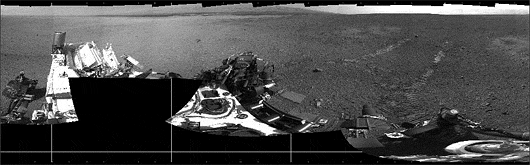
This 360-degree panorama (click it for a larger view) shows evidence of a successful first test drive for NASA’s Curiosity rover. On Aug. 22, 2012, the rover made its first move, going forward about 15 feet (4.5 meters), rotating 120 degrees and then reversing about 8 feet (2.5 meters). Curiosity is about 20 feet (6 meters) from its landing site, now named Bradbury Landing. Visible in the image are the rover’s first track marks. A small 3.5-inch (9-centimeter) rock can be seen where the drive began, which engineers say was partially under one of the rear wheels. Scour marks left by the rover’s descent stage during landing can be seen to the left and right of the wheel tracks. The lower slopes of Mount Sharp are visible at the top of the picture, near the center. This mosaic from the rover’s Navigation camera is made up of 23 full-resolution frames, displayed in a cylindrical projection. Image credit: NASA/JPL-Caltech
NASA has approved the Curiosity science team’s choice to name the landing ground for the influential author, who was born 92 years ago today and died this year. The location where Curiosity touched down is now called Bradbury Landing.
“This was not a difficult choice for the science team,” said Michael Meyer, NASA program scientist for Curiosity. “Many of us and millions of other readers were inspired in our lives by stories Ray Bradbury wrote to dream of the possibility of life on Mars.”

This image shows the tracks left by NASA’s Curiosity rover on Aug. 22, 2012, as it completed its first test drive on Mars. The rover went forward 15 feet (4.5 meters), rotated 120 degrees and then reversed 8.2 feet (2.5 meters). Curiosity is now 20 feet (6 meters) from its landing site, named Bradbury Landing. This image was taken by a front Hazard-Avoidance camera, which has a fisheye lens. Image credit: NASA/JPL-Caltech
Yesterday’s drive confirmed the health of Curiosity’s mobility system and produced the rover’s first wheel tracks on Mars, documented in images taken after the drive. During a news conference at NASA’s Jet Propulsion Laboratory in Pasadena, Calif., the mission’s lead rover driver, Matt Heverly, showed an animation derived from visualization software used for planning the first drive.
“We have a fully functioning mobility system with lots of amazing exploration ahead,” Heverly said.
Curiosity will spend several more days of working beside Bradbury Landing, performing instrument checks and studying the surroundings, before embarking toward its first driving destination approximately 1,300 feet (400 meters) to the east-southeast.
“Curiosity is a much more complex vehicle than earlier Mars rovers. The testing and characterization activities during the initial weeks of the mission lay important groundwork for operating our precious national resource with appropriate care,” said Curiosity Project Manager Pete Theisinger of JPL. “Sixteen days in, we are making excellent progress.”
1. In a career spanning more than 70 years, Ray Bradbury inspired generations of readers to dream, think and create. A prolific author of hundreds of short stories and nearly 50 books (including The Martian Chronicles), as well as numerous poems, essays, operas, plays, teleplays and screenplays, Bradbury was one of the most celebrated writers of our time. He died earlier this year.
Filed under: Mars