Space Bugs for Blood Testing
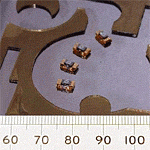
Thanks to ideas of putting swarms of tiny robot bugs to work on a future space station, patients being medicated for blood clots may soon get a simple, home-use testing kit, here on Earth.
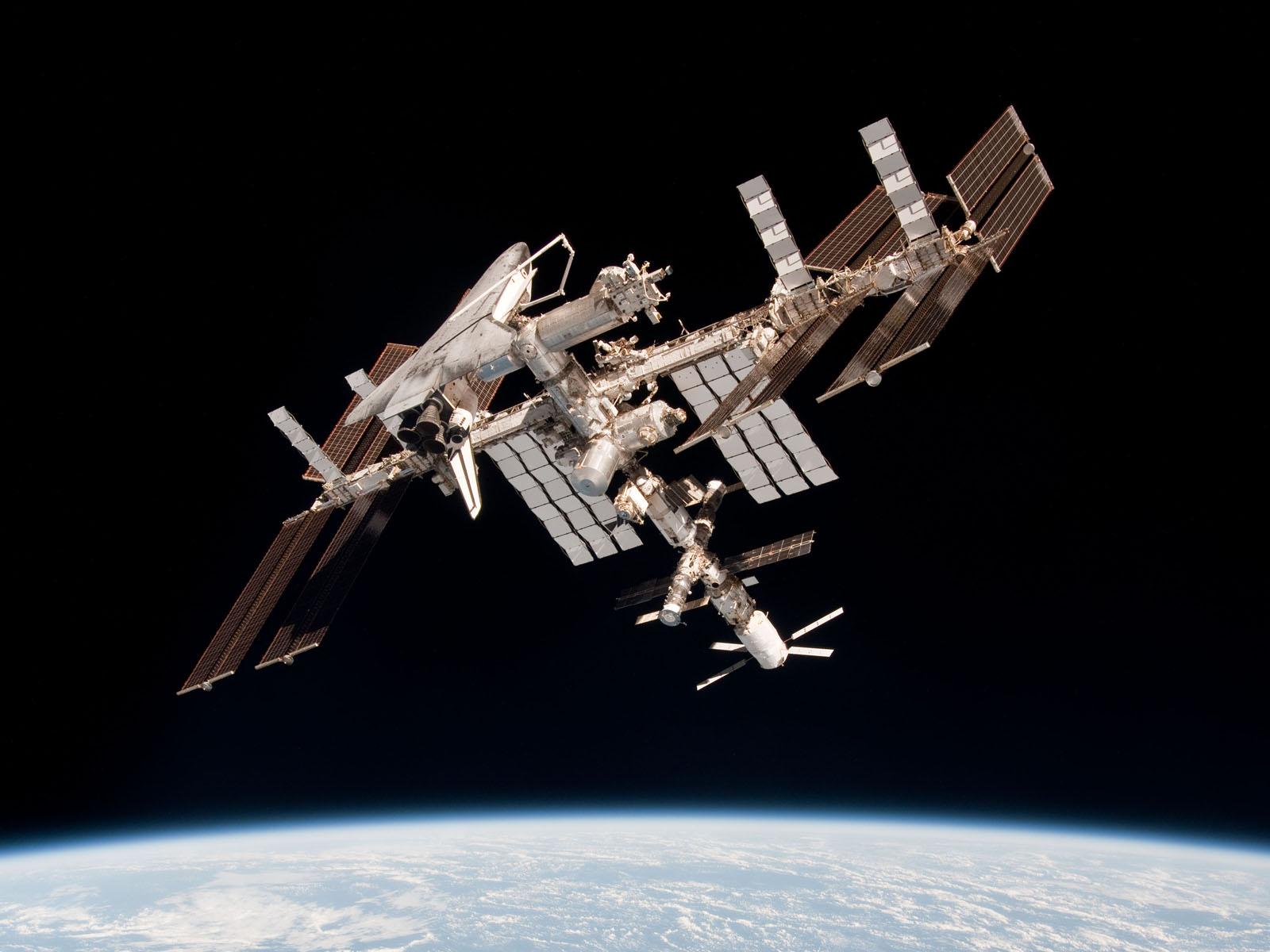
This image of the International Space Station with the docked Europe’s ATV Johannes Kepler and Space Shuttle Endeavour was taken by ESA astronaut Paolo Nespoli from Soyuz TMA-20 following its undocking on 24 May 2011. Credits: ESA/NASA
Fifteen years ago as a graduate student, Vladislav Djakov started building these micro-electromechanical creatures that mimic the swarms of bugs found in nature.
Equipped with a power supply, limited intelligence and monitoring systems, the bugs would be small enough to send en masse to hard-to-reach places, like pipes carrying liquids on space stations.
There, monitoring changes in temperature or flow could warn of impending malfunctions.

Prototypes of space bugs designed by Dr Vladislav Djakov to monitor fluids in space station pipes. The prototypes have a ‘brain’ chip, battery and a Micro Electro Mechanical System (MEMS) module used to move through the pipes. Dr Djakov’s development started at Rutherford Appleton Laboratory, part of the UK’s Science and Technology Facility Council and was partially funded by the British National Space Centre, now known as the UK Space Agency. The goal of the research was to evaluate Micro Electro Mechanical Systems for space applications. “We also looked at using cantilevers for micro-optical applications in space, which could reduce the size of infrared-based space spectrometers,” recalled Dr Djakov. The further work to spin off of this space technology was done by Dr Djakov’s team at Microvisk and started in 2004. The company is completing clinical trials in preparation for the launch in 2013 of its two coagulometers: CoagMax aimed at medical doctors and CoagLite designed for home-testing by patients themselves. Credits: V. Djakov
To move the bugs, the scientist hit on using cilia-like motion, much like some deep-sea creatures use to propel themselves. They covered one face of the microchip with tiny cantilever arms.
“They would then move along on these like millipedes,” said Dr Djakov, now Director of Sensor Development at Microvisk Technologies.
In the end, the space bugs were ahead of their time: they haven’t yet progressed past the testing phase.
But the cilia approach – the cantilever arms to propel the bugs – has gone further.
Space cantilevers spin off
STFC Innovation, ESA’s Technology Transfer Programme partner that operates the agency’s Business Incubation Centre Harwell in the UK, saw the business potential in the medical market and supported start-up company Microvisk to spin off the technology.
At Microvisk, Dr Djakov’s team stripped down the microchips and put the intelligent sensing mechanisms right into the cantilever arms, almost like a cat’s whiskers.
These whiskers turned out to be very good at monitoring liquids. Sweeping through, they note changes in viscosity and register if anything is suspended in the liquid.
“This is very interesting for probing blood, plasma, and other bodily fluids,” said Dr Djakov.
At present, investors are betting on a device to monitor blood coagulation for patients taking blood thinner medication: “It’s like a diabetes test, but for thrombosis.”
Thanks to this coagulometer, the Microvisk CoagLite, patients will soon be able to test themselves at home with the prick of a finger.
After a small chamber inside the test strip fills with blood, the tiny cantilever sweeps the drop, monitoring how quickly it coagulates.
“You need less blood, which means there is less pain,” said Dr Djakov, who compared its ease-of-use to diabetics’ simple glucose monitors. “Haematologists are finding it really important.”
Now undergoing clinical testing with US Food and Drug Administration, the coagulometer should be on the market later next year.

Microvisk’s hand-held CoagMax instrument designed for doctors and hospital staff to measure patients’ blood coagulation . It is based on the same technology as the consumer-model CoagLite but the results can be sent to a central computer database for easy comparison with previous readings. Credits: Microvisk Ltd
But the whisker technology isn’t limited to testing blood.
“It would be good for things like plasma or teardrops,” said Dr Djakov, “or to test the oil in a car engine, or in the food industry, to test chocolate or ketchup.
“There are literally hundreds of applications, for this innovation which started as a ‘space bug’.”


