ESA’s Intermediate eXperimental Vehicle Gets Revised Timeline

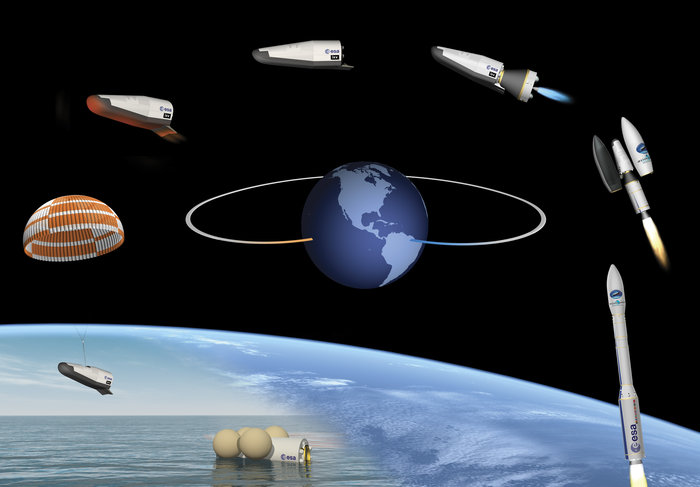
An annotated timeline of the most critical events during the IXV mission. ESA’s wingless spaceplane is set for liftoff on a Vega rocket from Kourou, French Guiana, 11 February 2015.
ESA’s Intermediate eXperimental Vehicle (IXV) will be launched on Vega flight VV04 at 13:00 GMT (14:00 CET) for a suborbital flight to test technologies and critical systems for Europe’s future automated re-entry systems.
After separation from Vega at about 340 km altitude 18 minutes into flight, it will coast up to a maximum height of about 420 km. Next, it will begin reentry, recording data from a large number of conventional and advanced sensors.
The entry speed of 27,000 km/h (7.5 km/s) creates the same conditions as those for a vehicle returning from low orbit. It will navigate through the atmosphere within its reentry corridor before descending, slowed by a multistage parachute, for a safe splashdown in the Pacific Ocean some 100 minutes after liftoff.
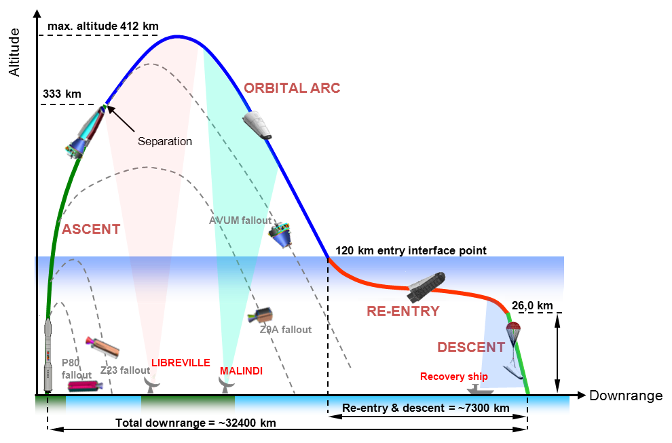
The IXV mission includes launch on a Vega from Kourou, French Guiana, into a semi-equatorial path, followed by a landing in the Pacific Ocean to await recovery by ship and post-flight analysis. The main flight phases are: ascent, separation, ballistic, reentry, descent and splashdown. Image credit: ESA
The spacecraft will fly fully autonomously, and will be closely monitored from its Mission Control Centre located at the Advanced Logistics Technology Engineering Centre in Turin, Italy. Signals from the spacecraft will be tracked by two ground stations in Africa and by an antenna on the recovery ship, Nos Aries.
On 11 February, follow the mission live starting 12:30 GMT (13:30 CET) via Arianespace TV and ESA TV.
Top image: The Intermediate eXperimental Vehicle (IXV) project objectives tackle the basic European needs for reentry from LEO, consolidating the knowledge necessary for the development of any future European reentry system while allowing risk limitation.
It will be launched by ESA in 2014 on Vega, Europe’s new small launcher, into a suborbital path, from Europe’s Spaceport in French Guiana. After being launched into space, IXV will return to Earth as if from a low-orbit mission, testing brand-new European atmospheric reentry technologies during its hypersonic and supersonic flight phases. Image credit: ESA–J. Huart, 2014
Source: ESA
Have something to add to this story? Share it in the comments.


