Mars Express Prepared for Comet Siding Spring Close Encounter

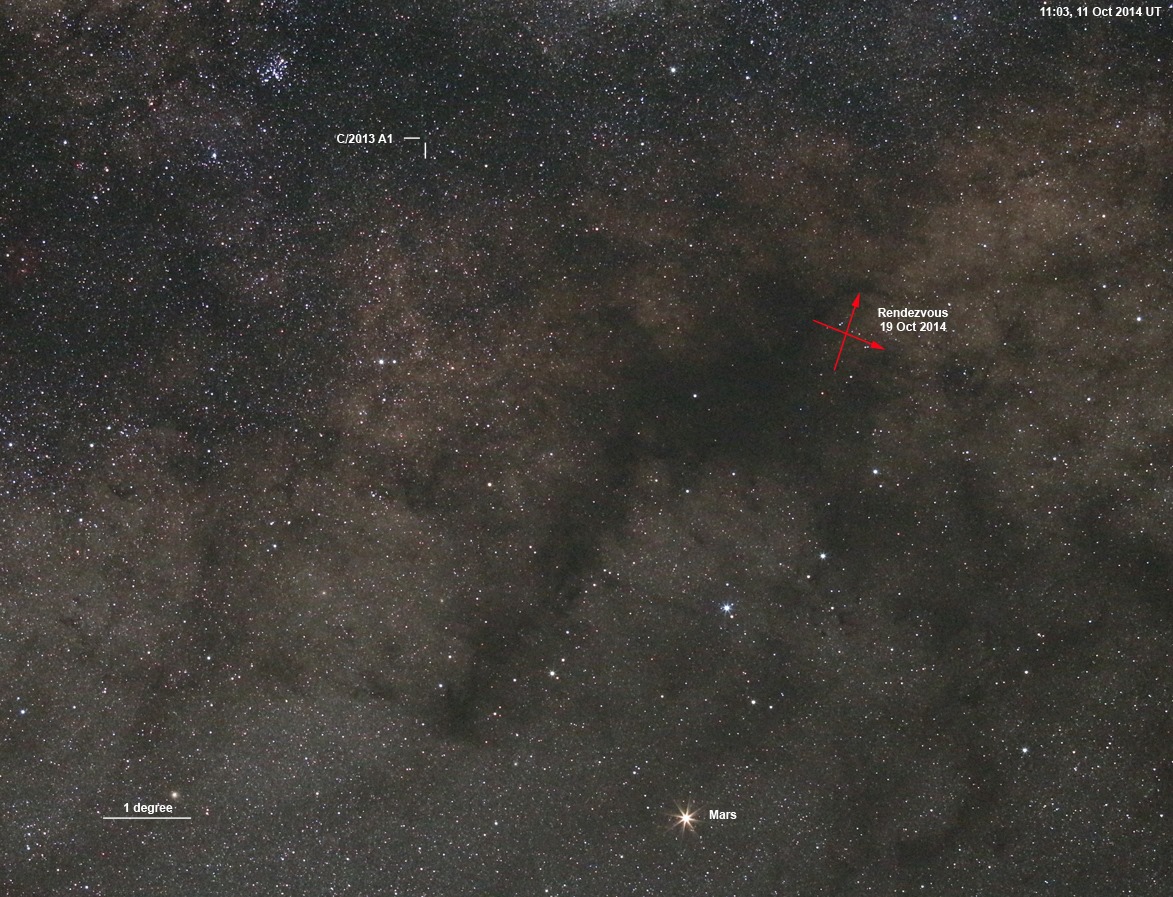
This weekend, Comet Siding Spring (C/2013 A1) will make a historically close approach to Mars. Satellites and rovers will get an eye-full as the green comet passes less than 140,000 km (87,000 miles) above the Red Planet’s surface. No one knows what will happen. Possible side-effects of the flyby include a Martian meteor shower and auroras.
Europe’s Mars orbiter and its scientific instruments will have a frontrow seat on Sunday when Comet Siding Spring grazes the Red Planet, skimming past at a little more than a third of the Moon’s distance from Earth.
Comet Siding Spring, discovered in January 2013, is less than a kilometre across and will pass Mars at 56 km/s, closing to within 139 500 km at 18:27 GMT (20:27 CEST) on 19 October.
Initially, the comet and its envelope of gas and dust were predicted to pass much closer to Mars, posing a serious risk to the fleet of orbiting spacecraft. Later observations confirmed that the miss distance will, in fact, be more comfortable.
ESA’s teams flying Mars Express have spent months preparing for the encounter.
“In 2013, we had very little information about the comet, which was still very far and faint. In the worst case, we expected the pass to be much closer, and the comet to be much more active,” says Spacecraft Operations Manager Michel Denis.
“We designed a special mode for Mars Express that would minimise any risk due to impacts with cometary particles.
“This included turning off all instruments and non-essential onboard systems, and turning the spacecraft so as to use the large high-gain antenna as a shield.”
Opportunity for unique science

Mars Express lifted off from Baikonur Cosmodrome aboard a Soyuz–Fregat on 2 June 2003. It entered orbit around Mars on 25 December that year and reached its operational orbit in January 2004. The initial mission duration was one martian year (687 Earth days), completed in September 2005. The mission has since been extended five times; the current extension is until 31 December 2014. Image credit: ESA/Alex Lutkus
Instead, Mars Express will operate substantially normally, and the close flyby will present an invaluable opportunity for science, including close-up observations of this enigmatic comet, the Mars atmosphere under the direct influence of the comet’s gas and dust, and the complex three-way interaction between Mars, the comet and the solar wind.
The detailed observation plans include high-resolution imaging of the comet and its structure.
“Most interestingly, we may also obtain images of cometary particles – meteors – burning up in the martian atmosphere, allowing an in-depth comparison of meteor science between Earth and Mars,” notes Håkan Svedhem, project scientist for Mars Express.
Oort Cloud object comes near
Siding Spring spent most of its life in the Oort Cloud, a shell surrounding our Sun some 5000–100 000 times the Earth–Sun distance and containing billions of comets thought to be left over from the formation of our Solar System.
“The best estimate of the maximum distance of Siding Spring is 60 000 times Earth’s distance from the Sun – almost exactly a light-year,” says Håkan.
“This makes it an extraordinary comet. It has most likely never been close to the Sun before.”
Siding Spring will be the first Oort Cloud comet to be studied up close by spacecraft, giving scientists an invaluable opportunity to learn more about the materials, including water and carbon compounds, that existed during the formation of the Solar System 4.6 billion years ago.
Despite the much reduced risk of particle impacts on Mars Express, the control team will be watching closely on Sunday evening to ensure its safety.
Updates will be posted in the Mars Express blog and a webcast from ESA’s Space Operations Centre, ESOC, in Darmstadt, Germany, will be streamed live 19 October, starting at 17:50 GMT (19:50 CEST).
Top image: Comet C/2013 A1 Siding Spring and Mars in the same image, with the closest approach location marked with red arrows, by an amateur astronomer in Australia. Closest approach takes place 19 October 2014 at 18:27 GMT (20:27 CEST). Image credit: R. Kaufman
Have something to add to this story? Share it in the comments.


