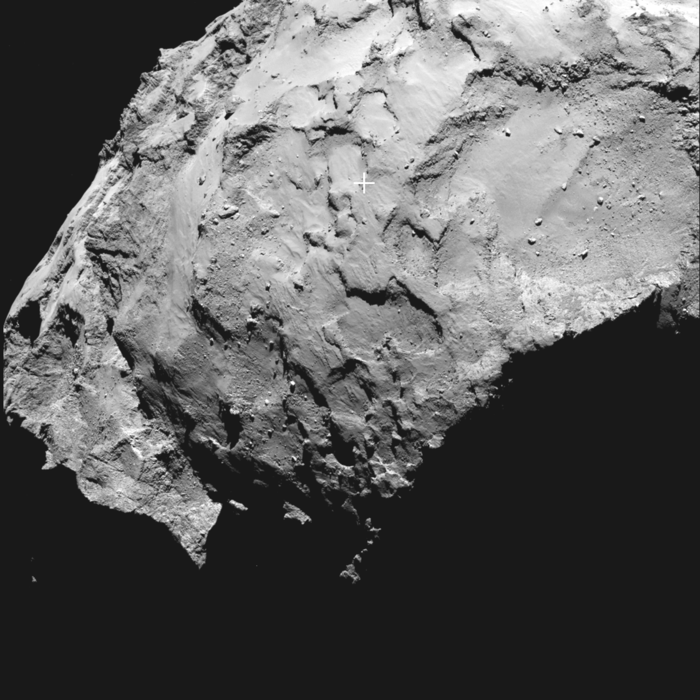
Rosetta’s lander Philae will target Site J, an intriguing region on Comet 67P/Churyumov–Gerasimenko that offers unique scientific potential, with hints of activity nearby, and minimum risk to the lander compared to the other candidate sites.
Site J is on the ‘head’ of the comet, an irregular shaped world that is just over 4 km across at its widest point. The decision to select Site J as the primary site was unanimous. The backup, Site C, is located on the ‘body’ of the comet.
The 100 kg lander is planned to reach the surface on 11 November, where it will perform indepth measurements to characterise the nucleus in situ, in a totally unprecedented way.
But choosing a suitable landing site has not been an easy task.
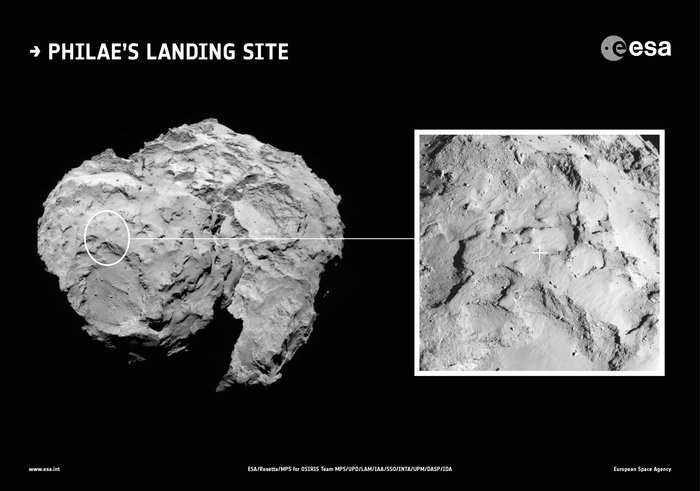
Context image showing the location of the primary landing site for Rosetta’s lander Philae. Site J is located on the head of Comet 67P/Churyumov–Gerasimenko. An inset showing a close up of the landing site is also shown. The inset image was taken by Rosetta’s OSIRIS narrow-angle camera on 20 August 2014 from a distance of about 67 km. The image scale is 1.2 metres/pixel. The background image was taken on 16 August from a distance of about 100 km. The comet nucleus is about 4 km across. The primary landing site was chosen from five candidates during the Landing Site Selection Group meeting held on 13–14 September 2014. Credits: ESA/Rosetta/MPS for OSIRIS Team MPS/UPD/LAM/IAA/SSO/INTA/UPM/DASP/IDA
“As we have seen from recent close-up images, the comet is a beautiful but dramatic world – it is scientifically exciting, but its shape makes it operationally challenging,” says Stephan Ulamec, Philae Lander Manager at the DLR German Aerospace Center.
“None of the candidate landing sites met all of the operational criteria at the 100% level, but Site J is clearly the best solution.”
“We will make the first ever in situ analysis of a comet at this site, giving us an unparalleled insight into the composition, structure and evolution of a comet,” says Jean-Pierre Bibring, a lead lander scientist and principal investigator of the CIVA instrument at the IAS in Orsay, France.
“Site J in particular offers us the chance to analyse pristine material, characterise the properties of the nucleus, and study the processes that drive its activity.”
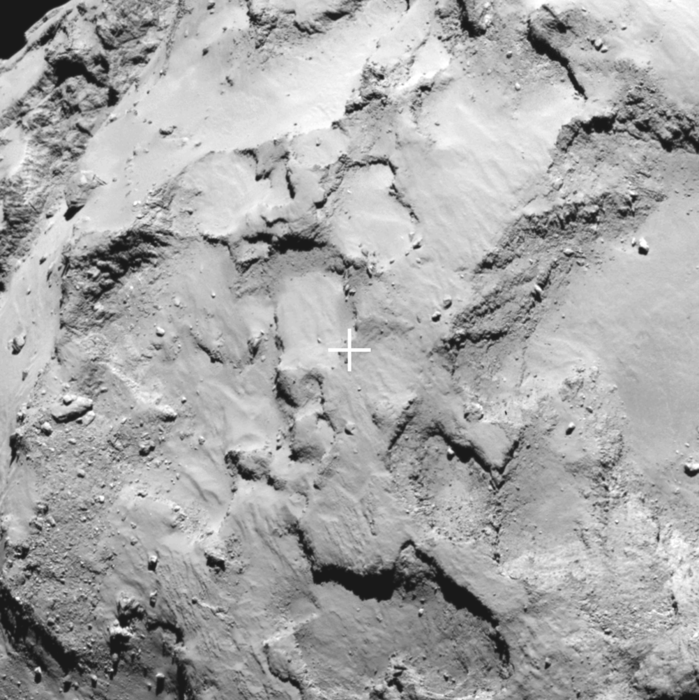
Close-up of Philae’s primary landing site J, which is located on the ‘head’ of Comet 67P/Churyumov–Gerasimenko. The image was taken by Rosetta’s OSIRIS narrow-angle camera on 20 August 2014 from a distance of about 67 km. The image scale is 1.2 metres/pixel. Site J offers the minimum risk to the lander in comparison to the other candidate sites, and is also scientifically interesting, with signs of activity nearby. At Site J, the majority of slopes are less than 30º relative to the local vertical, reducing the chances of Philae toppling over during touchdown. Site J also appears to have relatively few boulders and receives sufficient daily illumination to recharge Philae and continue science operations on the surface beyond the initial battery-powered phase. The primary landing site was selected during the Landing Site Selection Group meeting held 13–14 September 2014. Credits: ESA/Rosetta/MPS for OSIRIS Team MPS/UPD/LAM/IAA/SSO/INTA/UPM/DASP/IDA
The race to find the landing site could only begin once Rosetta arrived at the comet on 6 August, when the comet was seen close-up for the first time. By 24 August, using data collected when Rosetta was still about 100 km from the comet five candidate regions had been identified for further analysis.
Since then, the spacecraft has moved to within 30 km of the comet, affording more detailed scientific measurements of the candidate sites. In parallel, the operations and flight dynamics teams have been exploring options for delivering the lander to all five candidate landing sites.
Over the weekend, the Landing Site Selection Group of engineers and scientists from Philae’s Science, Operations and Navigation Centre at France’s CNES space agency, the Lander Control Centre at DLR, scientists representing the Philae Lander instruments and ESA’s Rosetta team met at CNES, Toulouse, France, to consider the available data and to choose the primary and backup sites.

This anaglyph image of Philae’s primary landing site on the ‘head’ of Comet 67P/Churyumov–Gerasimenko can be viewed using stereoscopic glasses with red–green/blue filters. The two images used to make the anaglyph were taken on 26 August 2014 from a distance of 48 km with Rosetta’s OSIRIS narrow-angle camera. The image scale is 0.96 metres/pixel. The primary landing location, Site J, was selected during the Landing Site Selection Group meeting held 13–14 September 2014. Credits: ESA/Rosetta/MPS for OSIRIS Team MPS/UPD/LAM/IAA/SSO/INTA/UPM/DASP/IDA
A number of critical aspects had to be considered, not least that it had to be possible to identify a safe trajectory for deploying Philae to the surface and that the density of visible hazards in the landing zone should be minimal. Once on the surface, other factors come into play, including the balance of daylight and nighttime hours, and the frequency of communications passes with the orbiter.
The descent to the comet is passive and it is only possible to predict that the landing point will place within a ‘landing ellipse’ typically a few hundred metres in size.
A one square kilometre area was assessed for each candidate site. At Site J, the majority of slopes are less than 30º relative to the local vertical, reducing the chances of Philae toppling over during touchdown. Site J also appears to have relatively few boulders, and receives sufficient daily illumination to recharge Philae and continue science operations on the surface beyond the initial battery-powered phase.
Provisional assessment of the trajectory to Site J found that the descent time of Philae to the surface would be about seven hours, a length that does not compromise the on-comet observations by using up too much of the battery during the descent.
Both Sites B and C were considered as the backup, but C was preferred because of a higher illumination profile and fewer boulders. Sites A and I had seemed attractive during first rounds of discussion, but were dismissed at the second round because they did not satisfy a number of the key criteria.
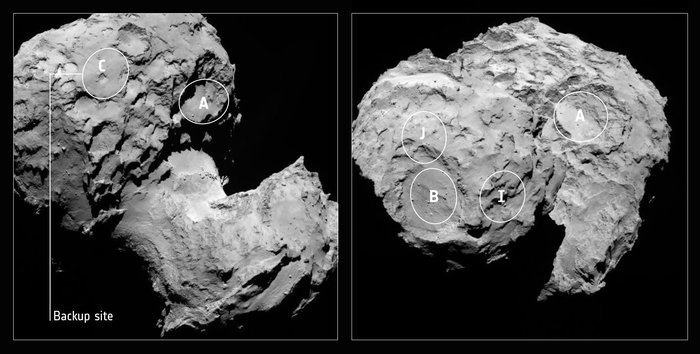
Context image of Comet 67P/Churyumov–Gerasimenko with the original five candidate landing sites for Rosetta’s lander Philae, and with the backup, Site C, indicated. The regions are marked on OSIRIS narrow-angle camera images taken on 16 August from a distance of about 100 km. The comet nucleus is about 4 km across. The sites were assigned a letter from an original preselection of 10 possible sites identified A to J. The lettering scheme does not signify any ranking. On 13 September, Site J was chosen as the primary, with Site C as the backup. Credits: ESA/Rosetta/MPS for OSIRIS Team MPS/UPD/LAM/IAA/SSO/INTA/UPM/DASP/IDA
A detailed operational timeline will now be prepared to determine the precise approach trajectory of Rosetta in order to deliver Philae to Site J. The landing must take place before mid-November, as the comet is predicted to grow more active as it moves closer to the Sun.
“There’s no time to lose, but now that we’re closer to the comet, continued science and mapping operations will help us improve the analysis of the primary and backup landing sites,” says ESA Rosetta flight director Andrea Accomazzo.
“Of course, we cannot predict the activity of the comet between now and landing, and on landing day itself. A sudden increase in activity could affect the position of Rosetta in its orbit at the moment of deployment and in turn the exact location where Philae will land, and that’s what makes this a risky operation.”

Site C was chosen as the backup site for Rosetta’s lander Philae during the Landing Site Selection Group meeting held on 13–14 September 2014. The image was taken by Rosetta’s narrow-angle camera from a distance of about 70 km. The resolution is 1.5 metres/pixel. Credits: ESA/Rosetta/MPS for OSIRIS Team MPS/UPD/LAM/IAA/SSO/INTA/UPM/DASP/IDA
Once deployed from Rosetta, Philae’s descent will be autonomous, with commands having been prepared by the Lander Control Centre at DLR, and uploaded via Rosetta mission control before separation.
During the descent, images will be taken and other observations of the comet’s environment will be made.
Once the lander touches down, at the equivalent of walking pace, it will use harpoons and ice screws to fix it onto the surface. It will then make a 360° panoramic image of the landing site to help determine where and in what orientation it has landed.
The initial science phase will then begin, with other instruments analysing the plasma and magnetic environment, and the surface and subsurface temperature. The lander will also drill and collect samples from beneath the surface, delivering them to the onboard laboratory for analysis. The interior structure of the comet will also be explored by sending radio waves through the surface towards Rosetta.
“No one has ever attempted to land on a comet before, so it is a real challenge,” says Fred Jansen, ESA Rosetta mission manager. “The complicated ‘double’ structure of the comet has had a considerable impact on the overall risks related to landing, but they are risks worth taking to have the chance of making the first ever soft landing on a comet.”
The landing date should be confirmed on 26 September after further trajectory analysis and the final Go/No Go for a landing at the primary site will follow a comprehensive readiness review on 14 October.
Top image: Philae’s primary landing site will target Site J, the centre of which is indicated by the cross in this OSIRIS narrow-angle image.
Site J is located on the head of Comet 67P/Churyumov–Gerasimenko and is close to the candidate site B, the large depression to the right of the image.
Site J offers the minimum risk to the lander in comparison to the other candidate sites, and is also scientifically interesting, with signs of activity nearby. At Site J, the majority of slopes are less than 30º relative to the local vertical, reducing the chances of Philae toppling over during touchdown. Site J also appears to have relatively few boulders and receives sufficient daily illumination to recharge Philae and continue science operations on the surface beyond the initial battery-powered phase.
Image credits: ESA/Rosetta/MPS for OSIRIS Team MPS/UPD/LAM/IAA/SSO/INTA/UPM/DASP/IDA
Have something to add to this story? Share it in the comments.
Filed under: Comets