The Three NASA Instruments Aboard Rosetta

Three NASA science instruments are being prepared for check-out operations aboard the European Space Agency’s Rosetta spacecraft, which is set to become the first to orbit a comet and land a probe on its nucleus in November.
Rosetta was reactivated Jan. 20 after a record 957 days in hibernation. U.S. mission managers are scheduled to activate their instruments on the spacecraft in early March and begin science operations with them in August. The instruments are an ultraviolet imaging spectrograph, a microwave thermometer and a plasma analyzer.
“U.S. scientists are delighted the Rosetta mission gives us a chance to examine a comet in a way we’ve never seen one before — in orbit around it and as it kicks up in activity,” said Claudia Alexander, Rosetta’s U.S. project scientist at NASA’s Jet Propulsion Laboratory in Pasadena, Calif. “The NASA suite of instruments will provide puzzle pieces the Rosetta science team as a whole will put together with the other pieces to paint a portrait of how a comet works and what it’s made of.”
Rosetta’s objective is to observe the comet 67P/Churyumov-Gerasimenko up close. By examining the full composition of the comet’s nucleus and the ways in which a comet changes, Rosetta will help scientists learn more about the origin and evolution of our solar system and the role comets may have played in seeding Earth with water, and perhaps even life.

Three of NASA’s contributions to the European Space Agency’s Rosetta mission are pictured here. An ultraviolet spectrometer called Alice (top) will analyze gases in the coma and tail and measure the comet’s production rates of water and carbon monoxide and dioxide. It will provide information on the surface composition of the nucleus, and make a potentially key measurement of argon, which will be a big clue about what the temperature was in the primordial solar system when the comet’s nucleus originally formed (more than 4.6 billion years ago).
Also pictured is the Ion and Electron Sensor (IES) (bottom left), which is part of a suite of five instruments to characterize the plasma environment of the comet — in particular, its coma, which develops when the comet approaches the sun. The sun’s outer atmosphere, the solar wind, interacts with the gas flowing out from the comet, and the instrument will measure the charged particles it comes in contact with as the orbiter approaches the comet’s nucleus.
The Microwave Instrument for Rosetta Orbiter (MIRO) (bottom right) specializes in measuring thermal properties. The instrument combines a spectrometer and radiometer, so it can sense temperature and identify chemicals located on or near the comet’s surface, and even in the dust and ices jetting out from it. The instrument will also see the gaseous activity through the dusty cloud of material. Rosetta scientists will use it to determine how different materials in the comet change from ice to gas, and to observe how much it changes in temperature as it approaches the sun. Image credit: NASA/JPL-Caltech/SwRI
The ultraviolet imaging spectrograph, called Alice, will analyze gases in the tail of the comet, as well as the coma, the fuzzy envelope around the nucleus of the comet. The coma develops as a comet approaches the sun. Alice also will measure the rate at which the comet produces water, carbon monoxide and carbon dioxide. These measurements will provide valuable information about the surface composition of the nucleus. The instrument also will measure the amount of argon present, an important clue about the temperature of the solar system at the time the comet’s nucleus originally formed more than 4.6 billion years ago.
The Microwave Instrument for Rosetta Orbiter will identify chemicals on or near the comet’s surface and measure the temperature of the chemicals and the dust and ice jetting out from the comet. The instrument also will see the gaseous activity in the tail through coma.
The Ion and Electron Sensor is part of a suite of five instruments to analyze the plasma environment of the comet, particularly the coma. The instrument will measure the charged particles in the sun’s outer atmosphere, or solar wind, as they interact with the gas flowing out from the comet while Rosetta is drawing nearer to the comet’s nucleus.
NASA also provided part of the electronics package the Double Focusing Mass Spectrometer, which is part of the Swiss-built Rosetta Orbiter Spectrometer for Ion and Neutral Analysis (ROSINA) instrument. ROSINA will be the first instrument with sufficient resolution to separate two molecules with approximately the same mass: molecular nitrogen and carbon monoxide. Clear identification of nitrogen will help scientists understand conditions at the time the solar system was born.
U.S. science investigators are partnering on several non-U.S. instruments and are involved in seven of the mission’s 21 instrument collaborations. NASA has an American interdisciplinary scientist involved in the research. NASA’s Deep Space Network is supporting the European Space Agency’s (ESA’s) Ground Station Network for spacecraft tracking and navigation.
Rosetta, composed of an orbiter and lander, is flying beyond the main asteroid belt. Its lander will obtain the first images taken from the surface of a comet, and it will provide the first analysis of a comet’s composition by drilling into the surface. Rosetta also will be the first spacecraft to witness, at close proximity, how a comet changes as it is subjected to the increasing intensity of the sun’s radiation.

This graphic timeline illustrates the milestones from Rosetta’s launch to its encounter with the comet 67P/Churyumov-Gerasimenko. Image credit: ESA/NASA
The potential research and data from the Rosetta mission could help inform NASA’s asteroid initiative — a mission to identify, capture and relocate an asteroid for astronauts to explore. The initiative represents an unprecedented technological feat that will lead to new scientific discoveries and technological capabilities that will help protect our home planet and achieve the goal of sending humans to an asteroid by 2025.
“Future robotic and human exploration missions to Mars, an asteroid and beyond will be accomplished via international partnerships combining worldwide scientific and engineering expertise,” said Jim Green, director of NASA’s Planetary Science Division in Washington. “Rosetta will provide an opportunity to study a small new world that could inform us on the best ways to approach, orbit and capture our target asteroid for a future human mission.”
The solar-powered spacecraft was placed into a deep sleep in June 2011 to conserve energy during the portion of its trajectory that carried it past the orbit of Jupiter. During Rosetta’s hibernation, all instruments and subsystems were shut off, except the main computer including a spacecraft clock and a few heaters. ESA mission managers are beginning to commission the spacecraft and its instruments.
“The successful wake-up of Rosetta from its long, lonely slumber is a testament to the teams that built and operate the spacecraft, and the international cooperation between ESA and NASA ensured that we had some of the world’s largest deep space dishes available to relay the first signal back to Earth,” said Mark McCaughrean, senior scientific advisor in ESA’s Directorate of Science and Robotic Exploration. “There is still a lot of work ahead of us before the exciting cometary rendezvous, escort, and landing phase, but it’s great to be back online.”
ESA member states and NASA contributed to the Rosetta mission. Airbus Defense and Space built the Rosetta spacecraft. JPL manages the US contribution of the Rosetta mission for NASA’s Science Mission Directorate in Washington. JPL also built the Microwave Instrument for the Rosetta Orbiter and hosts its principal investigator, Samuel Gulkis. The Southwest Research Institute in San Antonio developed the Rosetta orbiter’s Ion and Electron Sensor (IES) and hosts its principal investigator, James Burch. The Southwest Research Institute in Boulder, Colo., developed the Alice instrument and hosts its principal investigator, Alan Stern.
An audio replay of a media teleconference held Friday with NASA and ESA officials discussing the mission is available until Jan. 31. The call in number is: 800-839-2235 .
For information on the U.S. instruments.
More information about Rosetta is available here.
More information on the DSN.
More information on NASA’s asteroid initiative.
More information about Rosetta is available at www.esa.int/rosetta and http://rosetta.jpl.nasa.gov.
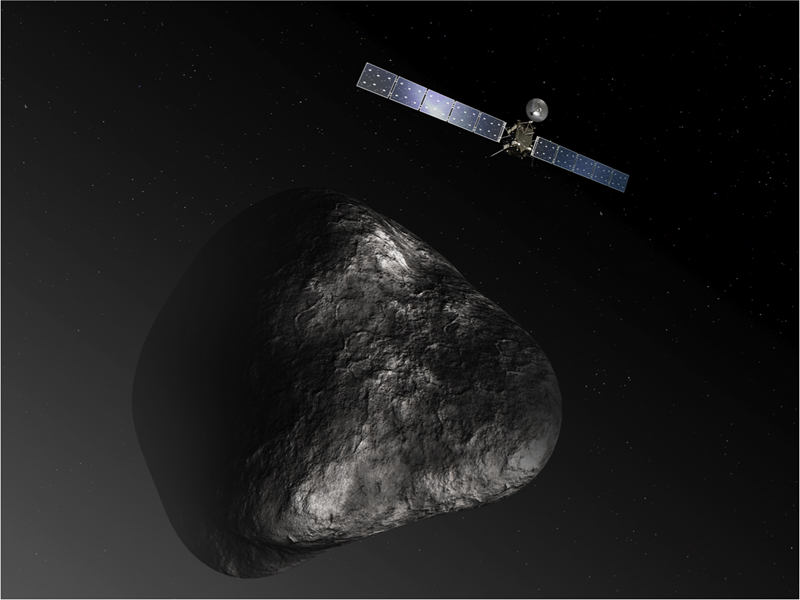
Top image: Artist’s impression of the Rosetta orbiter at comet 67P/Churyumov-Gerasimenko. The image is not to scale. The Rosetta spacecraft measures 105 feet (32 meters) across including the solar arrays, while the comet nucleus is thought to be about 2.5 miles (4 kilometers) wide.
Rosetta is a mission of the European Space Agency, Paris, with contributions from its member states and NASA. Rosetta’s Philae lander is provided by a consortium led by the German Aerospace Center, the Max Planck Institute for Solar System Research, the French National Space Agency and the Italian Space Agency. NASA’s Jet Propulsion Laboratory, Pasadena, Calif., manages the U.S. contribution to the Rosetta mission for NASA’s Science Mission Directorate in Washington.
Have something to add to this story? Share it in the comments.


