Intriguing Mounds of Juventae Chasma Revealed by Mars Express


Intriguing mounds of light-toned layered deposits sit inside Juventae Chasma, surrounded by a bed of soft sand and dust.
The origin of the chasma is linked to faulting associated with volcanic activity more than 3 billion years ago, causing the chasma walls to collapse and slump inwards, as seen in the blocky terrain in the right-hand side of this image.
At the same time, fracturing and faulting allowed subsurface water to spill out and pool in the newly formed chasm. Observations by ESA’s Mars Express and NASA’s Mars Reconnaissance Orbiter show that the large mounds inside the chasma consist of sulphate-rich materials, an indication that the rocks were indeed altered by water.
The mounds contain numerous layers that were most likely built up as lake-deposits during the Chasma’s wet epoch. But ice-laden dust raining out from the atmosphere – a phenomenon observed at the poles of Mars – may also have contributed to the formation of the layers.
While the water has long gone, wind erosion prevails, etching grooves into the exposed surfaces of the mounds and whipping up the surrounding dust into ripples.
The image was taken by the high-resolution stereo camera on ESA’s Mars Express on 4 November 2013 (orbit 12 508), with a ground resolution of 16 m per pixel. The image centre is at about 4°S / 298°E. Credits: ESA/DLR/FU Berlin (G. Neukum)

Colour-coded topography map of Juventae Chasma. White and red show the highest terrains, while blue and purple show the deepest.
The floor of Juventae Chasma sits some 5.8 km below the surrounding plateau. It is filled with sand in the southern part (left), which takes on a smooth appearance, in contrast to the northern (right) part of this image where many blocky rock fragments have slumped down from the chasma walls. Two large mounds of layered material sit inside Juventae Chasma and comprise minerals altered by water.
This region was imaged by the high-resolution stereo camera on ESA’s Mars Express on 4 November 2013 (orbit 12 508), with a ground resolution of 16 ms per pixel. The image centre is at about 4°S / 298°E. Credits: ESA/DLR/FU Berlin (G. Neukum)
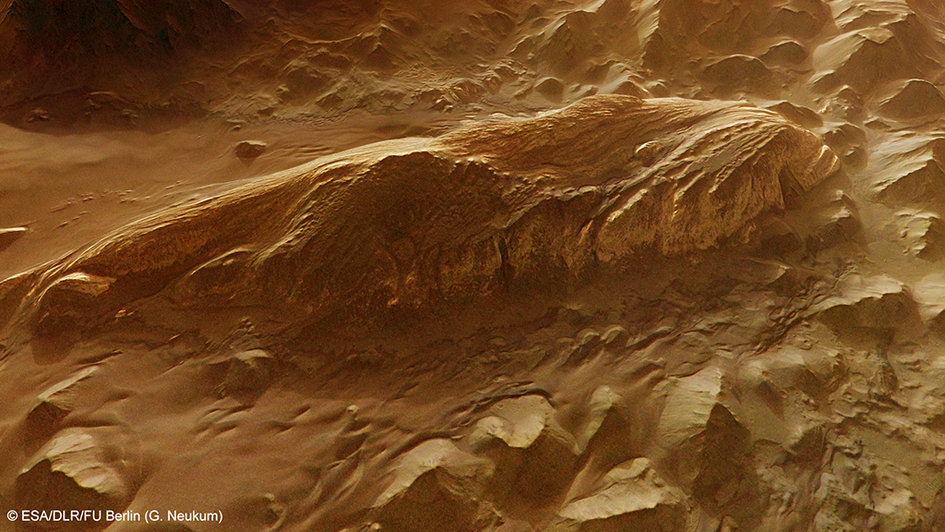
The largest layered mound in Juventae Chasma is seen here in close-up perspective view. It is about 53 km long, up to 20 km wide and rises some 3.3 km above the surrounding area, comparable to a small mountain range on Earth.
Its surface is etched with grooves carved by strong prevailing winds blowing through the chasma. Layers in the mound consist of sulphate-rich materials, an indication that the rocks have been altered by water.
The mound is a relic of at least 3 billion years of martian history and its layers were most likely built up as lake deposits over time. But ice-laden dust raining out from the atmosphere – a phenomenon observed at the poles of Mars – may also have contributed to the formation of the layers.
This region was imaged by the high-resolution stereo camera on ESA’s Mars Express on 4 November 2013 (orbit 12,508), with a ground resolution of 16 m per pixel. The image centre is at about 4°S / 298°E. Credits: ESA/DLR/FU Berlin (G. Neukum)

Data from the nadir channel and one stereo channel of the high-resolution stereo camera on ESA’s Mars Express have been combined to produce this anaglyph 3D image of Juventae Chasma, which can be viewed using stereoscopic glasses with red–green or red–blue filters.
This region was imaged on 4 November 2013 (orbit 12 508), with a ground resolution of 16 ms per pixel. The image centre is at about 4°S / 298°E. Credits: ESA/DLR/FU Berlin (G. Neukum)
Have something to add to this story? Share it in the comments.


