Subaru Telescope’s New Camera Takes Stunning Image of Andromeda Galaxy
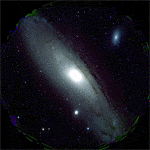

This stunning image of M31 captured by Subaru Telescope‘s Hyper Suprime-Cam (HSC) displays the fruits of international collaboration and technological sophistication aligned with cutting-edge science. The telescope has a large 1.5-degree field of view.
In addition to providing information about a nearby galaxy that resembles our own, this image demonstrates HSC’s capability to fulfill Subaru Telescope’s intention of producing a large-scale survey of the Universe.
The combination of a large mirror, a wide field of view, and sharp imaging represents a giant step into a new era of observational astronomy and will contribute to answering questions about the nature of dark energy and matter. It marks another successful stage in HSC’s commissioning process, which involves checking all of HSC’s capabilities before it is ready for open use.
M31, also known as the Andromeda Galaxy, is the spiral galaxy nearest to our own Milky Way Galaxy, 2.5 million light years from Earth. It is one of the brightest objects listed in the Messier catalog and has garnered the attention of observers since 964 A.D., when the Persian astronomer al-Sufi wrote about it.
Messier catalogued it as M31 in 1764, 800 years later, and it continues to intrigue the public and astronomers alike. It is visible to the naked eye on moonless nights, even in areas with moderate light pollution.
Astronomers find it particularly interesting, because it is quite similar to the Milky Way Galaxy and can provide valuable information about how our own galaxy formed. Since the galactic center is visible, it is possible to investigate how star formation varies in relation to distance from the center of the galaxy.
The inaugural shot of Andromeda is only the beginning for the Hyper-Suprime Cam. The plan is to have the HSC take shots of every galaxy we can find, and then use all that data to learn more about how these giant masses of matter bend light around them in a phenomenon called “gravitational lensing.”
By analyzing galaxies that are gravitationally lensed, astronomers can study how much matter is in the universe, and better understand its invisible component, dark matter. They also hope to probe the strange entity, called dark energy, that is causing the expansion of space to accelerate.