SETI, the Search for Extra-Terrestrial Intelligence, is an almost uniquely American affair. There was a time when it was funded by the US government, but that funding resource was withdrawn many years ago and SETI research has continued primarily due to private funding. Now the British want to do their bit for this under-funded research topic. Whatever the results – we find that that we’re alone in the Universe, or we’re not – will have profound implications for our culture and our religions and how we see our place in the cosmos at large.
British scientists are to make a concerted effort to look for alien life among the stars.
Academics from 11 institutions have set up a network to co-ordinate their Search for Extra-Terrestrial Intelligence.
The English Astronomer Royal, Sir Martin Rees, will act as patron.
The group is asking funding agencies for a small – about £1m a year – sum of money to support listening time on radio telescopes and for data analysis.
It would also help pay for research that considered new ways to try to find aliens.
Currently, most Seti work is done in the US and is funded largely through private donation.
UK Seti Research Network (UKSRN) co-ordinator Alan Penny said there was important expertise in Britain keen to play its part.
“If we had one part in 200 – half a percent of the money that goes into astronomy at the moment – we could make an amazing difference. We would become comparable with the American effort,” the University of St Andrews researcher told BBC News.
“I don’t know whether [aliens] are out there, but I’m desperate to find out. It’s quite possible that we’re alone in the Universe. And think about the implications of that: if we’re alone in the Universe then the whole purpose in the Universe is in us. If we’re not alone, that’s interesting in a very different way.”
The UKSRN held its first get-together at this week’s National Astronomy Meeting.
British researchers and facilities have had occasional involvement in Seti projects down the years.
The most significant was the use in 1998-2003 of Jodrell bank, and its 76m Lovell radio telescope, in Project Phoenix. This was a search for signals from about 1,000 nearby stars. Organised – and paid for – by the Seti Institute in California, it ultimately found nothing.
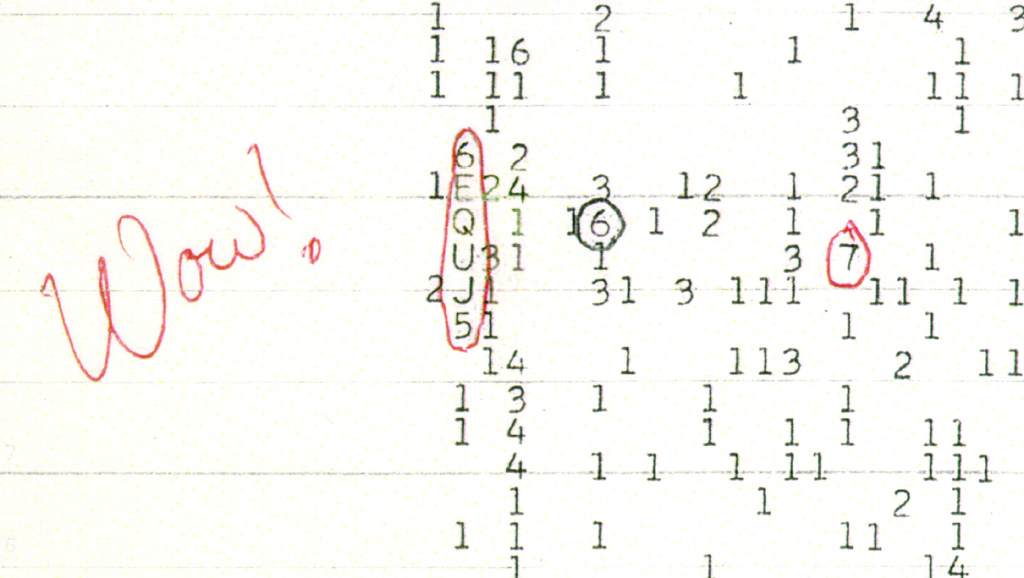
Nicknamed the “Wow!” signal, this was a brief burst of radio waves detected by astronomer Jerry Ehman who was working on a SETI project at the Big Ear radio telescope, Ohio, in 1977. The signal was, in fact, so remarkable that Ehman circled it on the computer printout, writing “Wow!” in the margin — and unintentionally giving the received radio signal the name under which it would become famous. Despite a lot of effort, no identification has been found for the signal’s source, and no repeat signal has ever been found. It’s a complete mystery. The only conclusion that can be drawn is if the signal truly did originate in deep space, then it was either an astrophysical phenomenon of which we’ve never seen before, or it truly was an intercepted alien signal. But here’s a thought: when humans sent out a signal using the Arecibo Radio Telescope in 1974, we only sent one signal. Maybe aliens did the same thing?
Jodrell has since been updated, linking it via fibre optics into a 217km-long array with six other telescopes across England. Known as eMerlin, this system would be a far more powerful tool to scan the skies for alien transmissions.
And Jodrell’s Tim O’Brien said Seti work could be done quite easily without disturbing mainstream science on the array.
“You could do serendipitous searches. So if the telescopes were studying quasars, for example, we could piggy-back off that and analyse the data to look for a different type of signal – not the natural astrophysical signal that the quasar astronomer was interested in, but something in the noise that one might imagine could be associated with aliens. This approach would get you Seti research almost for free,” the Jodrell associate director explained.
“There are billions of planets out there. It would be remiss of us not to at least have half an ear open to any signals that might be being sent to us.”
In addition to eMerlin, the UK is also heavily involved in Lofar – a European Low Frequency Array that incorporates new digital techniques to survey wide areas of the sky all at once.

Panoramic view of the Chilbolton LOFAR Station in Hampshire, England
And Jodrell itself is the management HQ for the forthcoming Square Kilometre Array, a giant next-generation radio observatory to be built in South Africa and Australia. It will have incredible power, not only to screen out interference from TV and phone signals here on Earth, but to resolve very faint signals at vast distances. It has been said the SKA could detect an airport radar on an alien world 50 light-years away.
One attraction of Seti is the great potential for “citizen science” involvement.
The Seti@Home screensaver has proved to be a big hit with the public, using downtime on home and business PCs to analyse radio telescope data for alien signals. The UK has a strong history in this area also with projects such as Galaxy Zoo, which sees citizen scientists help professional astronomers sift and classify the colossal numbers of images we now have of galaxy structures.
Sir Martin said there was huge public interest in the Seti question and some modest state funding for the area would probably get wide support.
“I’d put it this way: if you were to ask all the people coming out of a science fiction movie whether they’d be happy if some small fraction of the tax revenues from that movie were hypothecated to try to determine if any of what they’d just seen was for real, I’m sure most would say ‘yes’,” he told BBC News.
The issue is whether UK astronomy, currently operating under very tight fiscal constraints, can afford any spare cash for a field of endeavour that has completely unknown outcomes.
Sheffield University’s Paul Crowther doubted the Science and Technology Facilities Council (STFC), the main funders of UK astronomy, would be able to support UKSRN.
“Continued flat-cash science budget awards are constantly eroding STFC’s buying powers, causing the UK to withdraw from existing productive facilities such as the United Kingdom Infrared Telescope and the James Clerk Maxwell Telescope.
“[British astronomy] faces the prospect of a reduced volume of research grants, and participation in future high-impact facilities [eg the Large Synoptic Survey Telescope] is threatened. I would be shocked if STFC’s advisory panels rated the support of UKSRN higher than such scientifically compelling competition.”
Dr Penny argued Seti could make a strong case, and that his group would try to get research council backing.
“The human race wants to explore, wants to find things out, and if we stop trying we’re on the road to decay,” he said.
Top Image: The 76-metre Lovell Radio Telescope at Jodrell Bank Observatory, near Manchester in England
The original article is on the BBC News site.
Filed under: SETI