New View of the Horsehead Nebula Taken by Hubble and Herschel Space Telescopes
New views of the Horsehead Nebula and its turbulent environment have been unveiled by ESA’s Herschel space observatory and the NASA/ESA Hubble space telescope.

Stunning new view from ESA’s Herschel space observatory of the iconic Horsehead Nebula in the context of its surroundings. The image is a composite of the wavelengths of 70 microns (blue), 160 microns (green) and 250 microns (red), and covers 4.5×1.5 degrees. The image is oriented with northeast towards the left of the image and southwest towards the right.
The Horsehead Nebula resides in the constellation Orion, about 1300 light-years away, and is part of the vast Orion Molecular Cloud complex. The Horsehead appears to rise above the surrounding gas and dust in the far right-hand side of this scene, and points towards the bright Flame Nebula. Intense radiation streaming away from newborn stars heats up the surrounding dust and gas, making it shine brightly to Herschel’s infrared-sensitive eyes (shown in pink and white in this image).
To the left, the panoramic view also covers two other prominent sites where massive stars are forming, NGC 2068 and NGC 2071.
Extensive networks of cool gas and dust weave throughout the scene in the form of red and yellow filaments, some of which may host newly forming low-mass stars. Image credit: ESA/Herschel/PACS, SPIRE/N. Schneider, Ph. André, V. Könyves (CEA Saclay, France) for the “Gould Belt survey” Key Programme.
The Horsehead Nebula lies in the constellation Orion, about 1300 light-years away, and is a popular target for amateur and professional astronomers alike. It sits just to the south of star Alnitak, the easternmost of Orion’s famous three-star belt, and is part of the vast Orion Molecular Cloud complex.
The new far-infrared Herschel view shows in spectacular detail the scene playing out around the Horsehead Nebula at the right-hand side of the image, where it seems to surf like a ‘white horse’ in the waves of turbulent star-forming clouds.
It appears to be riding towards another favourite stopping point for astrophotographers: NGC 2024, also known as the Flame Nebula. This star-forming region appears obscured by dark dust lanes in visible light images, but blazes in full glory in the far-infrared Herschel view.

This three-panel image shows the latest near-infrared Hubble image of the Horsehead Nebula in context with the new wide-field Herschel view of the surrounding environment at far-infrared wavelengths.
A portion of the image highlighting both the Horsehead and Flame Nebula is also shown in visible light in an image from the Digitized Sky Survey 2 (DSS2). The star Altnitak is indicated – this is the most easterly star in Orion’s famous three-star belt. Several reflection nebulas are also indicated; these host star formation, and like the Horsehead and Flame, are popular targets for astrophotographers.
The Herschel image is 4.5×1.5 degrees and is oriented with northeast towards the left of the image and southwest towards the right. The image covers far-infrared wavelengths: 70 microns (blue), 160 microns (green) and 250 microns (red).
The Hubble image is approximately 6 arcminutes across and is oriented with north to the left and east down. The image is taken at near-infrared wavelengths: 1.1 microns (blue/cyan) and 1.6 microns (red/orange). Image credit: Herschel: ESA/Herschel/PACS, SPIRE/N. Schneider, Ph. André, V. Könyves (CEA Saclay, France) for the “Gould Belt survey” Key Programme, N. Schneider, Ph. André, V. Könyves (CEA Saclay); Hubble: NASA, ESA, and the Hubble Heritage Team (AURA/STScI); DSS2: ESO/Digitized Sky Survey 2, D. De Martin
Intense radiation streaming away from newborn stars heats up the surrounding dust and gas, making it shine brightly to Herschel’s infrared-sensitive eyes.
The panoramic view also covers two prominent sites of massive star formation to the northeast (left-hand side of this image), known as NGC 2068 (or M78) and NGC 2071. These take on the appearance of beautifully patterned butterfly wings, with long tails of colder gas and dust streaming away.
Both are reflection nebulas, so called because they reflect the light of nearby stars, revealing them even at visible wavelengths.
Extensive networks of cool gas and dust weave throughout the scene in the form of red and yellow filaments, some of which may host newly forming lightweight stars.
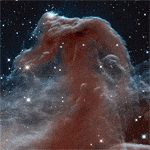
The new Hubble view, taken at near-infrared wavelengths with its Wide Field Camera 3 to celebrate the 23rd anniversary of the launch of the observatory, zooms in on the Horsehead to reveal fine details of its structure.
Nearby stars illuminate the backlit wisps along the upper ridge of the nebula in an ethereal glow. The harsh ultraviolet glare from these bright stars is slowly evaporating the dusty stellar nursery. Two fledgling stars have already been exposed from their protective cocoons, and can just be seen peeking out from the upper ridge.

The Horsehead Nebula as viewed at near-infrared wavelengths (1.1 microns (blue/cyan) and 1.6 microns (red/orange)) with the Wide Field Camera 3 on the NASA/ESA Hubble Space Telescope. The image is approximately 6 arcminutes across and is oriented with north to the left and east down.
This thick pillar of gas and dust is sculpted by powerful stellar winds blowing from clusters of massive stars located beyond the field of this image. The bright source at the top left edge of the nebula is a young star whose radiation is already eroding the surrounding interstellar material. Image credit: NASA, ESA & Hubble Heritage Team (AURA/STScI)
These latest views are also presented in a new fly-through animation, which puts the Horsehead in context and shows it at both visible and infrared wavelengths. The new views from Herschel and Hubble are complemented by ground-based images from other telescopes.