On February 15 near-earth Asteroid 2012 DA14 will come so close to Earth that it will pass inside the orbits of the geostationary satellites. The asteroid, which is about 45-50 metres (148-165 feet) in diameter will pass about 33,600 km (21,000 miles) from the center of the Earth, or about 27,200 km (17,000 miles) above the surface.
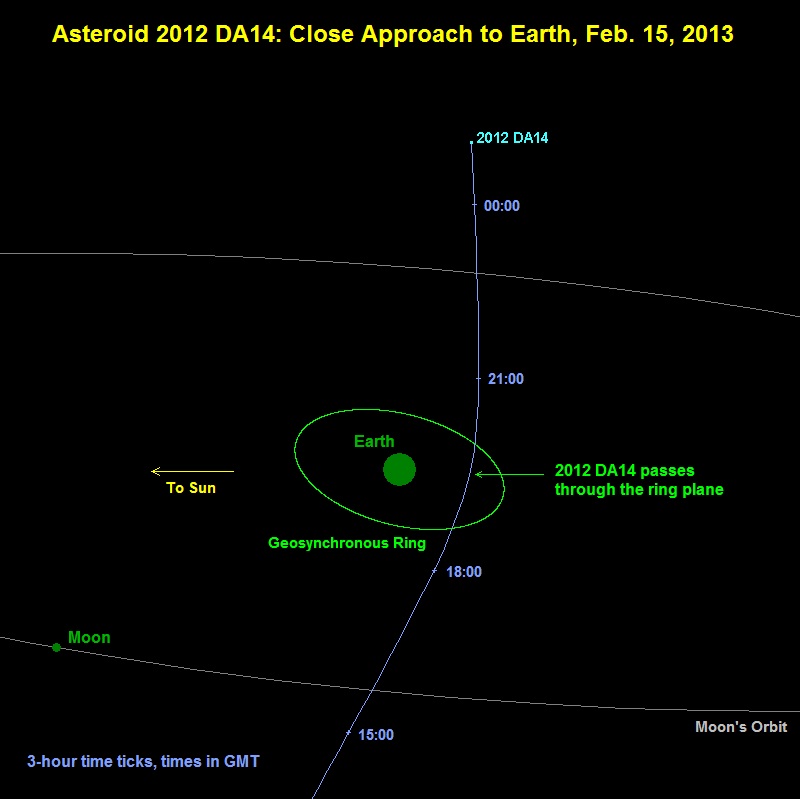
Plot of Asteroid 2012 DA14 as it passes by Earth
There is no risk of a collision, but if an object of this size did hit the Earth, the damage would be very significant. 27,200 km (17,000 miles) might seem like a significant distance, but it’s just over twice the diameter of the Earth. If a bullet was to miss your head by just twice your head’s diameter, you would think that it was one helluva near-miss! Asteroid 2012 DA14 will be travelling at 7.8 km per second (4.9 miles per sec).
The asteroid won’t affect Earth in any way. It won’t alter the tides. It won’t cause volcanoes. It’ll just sweep closely past us – as millions of asteroids have done throughout Earth’s four-and-a-half-billion-year history – some in your own lifetime.
It has been estimated that if it did hit the Earth, it would produce the equivalent of 2.4 megatons of TNT. The blast that was the Tunguska event in 1908 in Siberia has been estimated at 3 to 20 megatons. So 2012 DA14 is in the same approximate region as the Tunguska event. It would not destroy Earth, but it could flatten a city.
The asteroid was discovered by the LaSagra observatory in southern Spain in early 2012. Tthe asteroid will travel rapidly from the southern evening sky into the northern morning sky with its closest Earth approach occurring about 19:26 UTC when it will achieve a magnitude of less than seven, which is somewhat fainter than naked eye visibility. About 4 minutes after its close approach, there is a good chance it will pass into the Earth’s shadow for about 18 minutes or so before reappearing from the eclipse. When traveling rapidly into the northern morning sky, 2012 DA14 will quickly fade in brightness.
The orbit of 2012 DA14 is an inclined ellipse. In other words, it’s tilted sightly with respect to Earth’s orbit around the sun, and, like Earth’s orbit, it’s not circular but elliptical. The asteroid spends most of its time well away from our planet. However, its path does bring it somewhat close to the Earth twice per orbit, or about every six months. The last time it passed us was on February 16, 2012, when it was about 2.5 million km (1.5 million miles) away – about 6 times the distance to the moon.
Early in 2012, due to uncertainties in the asteroid’s orbit, it was estimated that there was one chance in 83,000 of it impacting with Earth, with additional remote possibilities beyond 2020. Later in 2012, the orbit was firmed up and it’s now known that there’s no possibility of a collision in 2020.
Planetary Society Director of Projects Bruce Betts reassures us in this brief and fascinating explanation of what will happen–and what WON’T happen–when this big asteroid comes closer to Earth than many satellites.
The asteroid should be visible in binoculars as it speeds past the Earth. Maximum magnitude is expected to be between 7 and 7.5.
Since it will be so close, and moving so fast, predictions need to be based on your own location, not geocentric coordinates.

The Heavens Above site can create an ephemeris for your location. Since the asteroid is moving so fast, the site only gives details of the position every half-hour on February 15th. But you can easily interpolate from those positions. The easiest way to find it will be to pick an easily identifiable spot in the sky, using a good star chart, through which the asteroid will pass when it is still fairly bright. Note the time when it will pass through that region of the sky. Train your binoculars or wide-field telescope on that area a few minutes before it is due, preferably while you are in a comfortable position to avoid strain, and then wait for the asteroid to appear as a moving point of light. If you lose sight of the object for more than a minute in your field of view, you will find it hard to pick it up again!
It should be possible to record the asteroid’s motion across the sky with a time exposure on a digital camera with a reasonable zoom lens, and set to a high ISO setting.
This will be the brightest-ever Near Earth Object (NEO) to be observed approaching the vicinity of our planet (<0.1 AU). It is predicted to be 30 times brighter and more than 150 times more massive than the next largest known object to approach as close or closer to our planet in recent years: that one was Asteroid 2012 MD.

Filed under: Asteroids & NEOs