Penumbral Lunar Eclipse: July 7, 2009
A penumbral lunar eclipse will take place on July 7, 2009, the second of four lunar eclipses in 2009. This eclipse will only enter the southern most tip of the penumbral shadow and thus will be very difficult to observe visually.

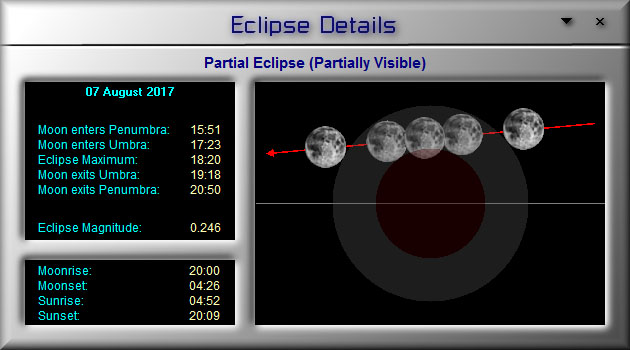
Penumbral eclipse details from LunarPhase Pro [click to enlarge image]. The light-grey ring shows the penumbral shadow. The moon’s northern limb only just enters the penumbra.
It will be seen rising over Australia after dusk on July 7, and setting over western North and South America in the early predawn hours of July 7.
July’s penumbral eclipse is only of academic interest since the magnitude is just 0.156.
About Eclipses
A lunar eclipse is an eclipse which occurs whenever the moon passes behind the earth so that the earth blocks the sun’s rays from striking the moon. This can occur only when the Sun, Earth, and Moon are aligned exactly, or very nearly so, with the Earth in the middle. So there is always a full moon on the night of a lunar eclipse. The type and length of an eclipse depends on the Moon’s location relative to its orbital nodes. There won’t be another total lunar eclipse until December 21, 2010, but there are a number of penumbral and partial eclipses between now and then.
The shadow of the Earth can be divided into two distinctive parts: the umbra and penumbra. Within the umbra, there is no direct solar radiation, so the Earth’s shadow on the moon is easy to see. However, as a result of the Sun’s large angular size, solar illumination is only partially blocked in the outer portion of the Earth’s shadow, which is given the name penumbra. This is a much fainter shadow on the moon and more difficult to see.

Penumbral Eclipses
A penumbral eclipse occurs when the Moon passes through the Earth’s penumbra. The penumbra causes a subtle darkening of the Moon’s surface. A special type of penumbral eclipse is a total penumbral eclipse, where the moon lies exclusively within the Earth’s penumbra. Total penumbral eclipses are rare, and when these occur, that portion of the Moon which is closest to the umbra can appear somewhat darker than the rest of the Moon.
| More Information | |||||
| NASA document (PDF) on the Penumbral Lunar Eclipse of July 07, 2009. | |||||
[phpbay]observing moon, 100, “378”, “”[/phpbay]
Lunar Eclipse Videos:
[tubepress mode=”tag” tagValue=”Lunar Eclipse astronomy”]
| [phpostock]Lunar Eclipse,1[/phpostock] |


The earthand the moon were one.it was hit by an asteriod that they named THEAH….When this happened it broke apart and the moon and the earth were born…..I did some reserch on this as i named my baby daughter THEAH-SAFFRON PHOENIX, all to do with red fire and explosions in a way that is hard to explain…..But that is how the earth and moon came about….
A total lunar eclipse is when the Moon is totally within the Earth's shadow. So it's Sun->Earth->Moon, whereas a solar eclipse is Sun->Moon->Earth.
Well this is really cool because the last time there i think there was a solar eclipse was before I was born in huston and my parents told me about one in they could see from the Johnson space center (yes they were roket scientists) and the told me it was annular so it was like twilight outside. I remember a luner eclipse from i think maybe last year or the year before and it was really detailed because you could see the zig-zag shadow on the moon of mountains it didn't last long but it was still cool to see. Anyway ithink it cool how people are able to track and see when a solar eclipce will happen