Pluto Geology

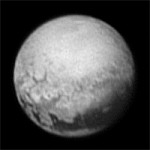
It began as a point of light. Then, it evolved into a fuzzy orb. Now – in its latest portrait from NASA’s New Horizons spacecraft – Pluto is being revealed as an intriguing new world with distinct surface features, including an immense dark band known as the “whale.”

As the newest black and white image from New Horizons’ Long Range …

Read the rest of this article
ESA’s Venus Express spacecraft has discovered that our cloud-covered neighbour spins a little slower than previously measured. Peering through the dense atmosphere in the infrared, the orbiter found surface features were not quite where they should be.


Venus Express in orbit since 2006 around our nearest planetary neighbour. Credits: ESA

Using the VIRTIS instrument at infrared wavelengths to penetrate the …

Read the rest of this article
NASA’s Dawn spacecraft spent the last four years voyaging to asteroid Vesta – and may have found a planet.

Vesta was discovered over two hundred years ago but, until Dawn, has been seen only as an indistinct blur and considered little more than a large, rocky body. Now the spacecraft’s instruments are revealing the true complexity of this ancient world.…

Read the rest of this article

NASA scientists will be tracking asteroid 2005 YU55 with antennas of the agency’s Deep Space Network at Goldstone, Calif., as the space rock safely flies past Earth slightly closer than the moon’s orbit on Nov. 8. Scientists are treating the flyby of the 1,300-foot-wide (400-meter) asteroid as a science target of opportunity – allowing instruments on “spacecraft Earth” to scan …

Read the rest of this article
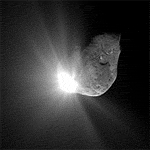
NASA’s Stardust spacecraft returned new images of a comet showing a scar resulting from the 2005 Deep Impact mission. The images also showed the comet has a fragile and weak nucleus.

The spacecraft made its closest approach to comet Tempel 1 on Monday, Feb. 14, at 8:40 p.m. PST (11:40 p.m. EST) at a distance of approximately 178 kilometers (111 …

Read the rest of this article
NASA is about to discover how solar heat devours a comet.


Stardust-NExT chases a comet, an artist’s concept. [more]

“For the first time, we’ll see the same comet before and after its closest approach to the sun,” explains Joe Veverka, principal investigator for NASA’s Stardust-NExT mission.

The comet is Tempel 1, which NASA’s Deep Impact probe visited in …

Read the rest of this article