As today’s partial solar eclipse crossed Europe, it was also visible from space. ESA’s Proba-2 captured a near-total eclipse from orbit, at the same time as its sister minisatellite Proba-V peered down to snap the shadow of the eclipse on Earth.

ESA astronaut Samantha Cristoforetti also found time while running an experiment to record the eclipse from the International Space …

Read the rest of this article
After 10-month voyage across more than 400 million miles of empty space, NASA’s MAVEN spacecraft reached Mars on Sept. 21st 2014. Less than 8 hours later, the data started to flow.

Our Imaging Ultraviolet Spectrograph (IUVS) obtained these false-color images of Mars on Sept. 22nd,” says Nick Schneider who leads the instrument team at the University of Colorado. …

Read the rest of this article

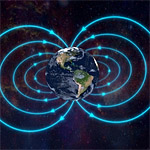
The first set of high-resolution results from ESA’s three-satellite Swarm constellation reveals the most recent changes in the magnetic field that protects our planet.

Launched in November 2013, Swarm is providing unprecedented insights into the complex workings of Earth’s magnetic field, which safeguards us from the bombarding cosmic radiation and charged particles.


‘Snapshot’ of the main magnetic field at Earth’s …

Read the rest of this article

For the first time, ESA is providing regular space-weather reports for a spacecraft orbiting another planet.

When your spacecraft is surfing deep into the atmosphere of an alien world, you need the latest information on conditions that could affect your trajectory.

If that planet is Venus, that means knowing what’s happening on our Sun in real time, because solar activity …

Read the rest of this article

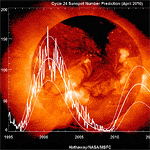
Last month (April 8-11), scientists, government officials, emergency planners and others converged on Boulder, Colorado, for NOAA’s Space Weather Workshop—an annual gathering to discuss the perils and probabilities of solar storms.

The current solar cycle is weaker than usual, so you might expect a correspondingly low-key meeting.  On the contrary, the halls and meeting rooms were abuzz with excitement about …

Read the rest of this article

Earth Day 2015

The next time you step onto an airplane, consider the following: In any given year, the pilot of your aircraft probably absorbs as much radiation as a worker in a nuclear power plant.

And you are about to follow him wherever he goes.

The FAA classifies pilots as “occupational radiation workers.” Flying high above Earth with little atmosphere to protect …

Read the rest of this article

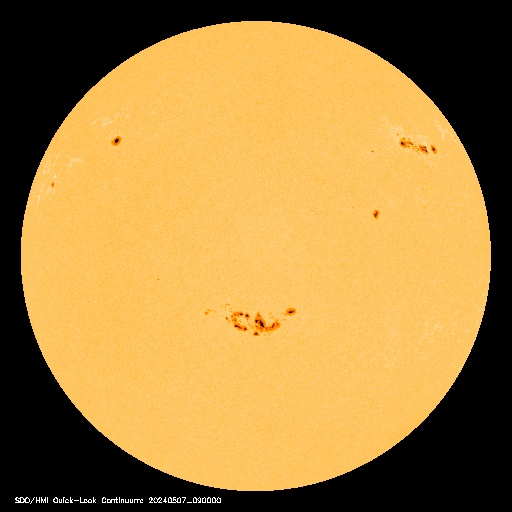
Something big is about to happen on the sun. According to measurements from NASA-supported observatories, the sun’s vast magnetic field is about to flip.

“It looks like we’re no more than 3 to 4 months away from a complete field reversal,” says solar physicist Todd Hoeksema of Stanford University. “This change will have ripple effects throughout the solar system.”

The …

Read the rest of this article

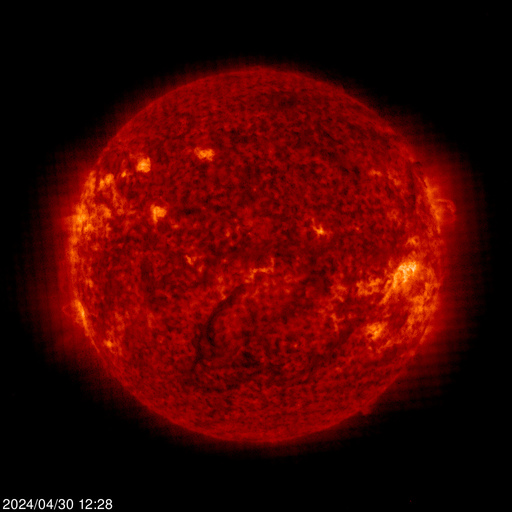
The Sun

ESA’s Sun-watching Proba-2 satellite has been in orbit since November 2009, demonstrating a range of technologies and serving as a platform for scientific observations.

The 130-kg satellite carries two solar monitors. One is SWAP (Sun Watcher using Active Pixel System detector and Image Processing), a small telescope that captures the solar corona at wavelengths corresponding to temperatures of about a …

Read the rest of this article
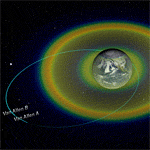
Using data from a NASA satellite, scientists have discovered a massive particle accelerator in the heart of one of the harshest regions of near-Earth space, a region of super-energetic, charged particles surrounding the globe and known as the Van Allen radiation belts.

New results from NASA’s Van Allen Probes show the acceleration energy is in the belts themselves. Local bumps …

Read the rest of this article

ESA today inaugurated a new hub that will strengthen Europe’s contribution to the global hunt for asteroids and other hazardous natural objects that may strike Earth.

Near-Earth Objects, or NEOs, are asteroids or comets with sizes ranging from metres to tens of kilometres that orbit the Sun and whose orbits come close to that of Earth. There are over 600 …

Read the rest of this article