The Veil Nebula

Discovered on 5 September 1784 by astronomer William Herschel, the Veil Nebula was once a star. Now it is a twisted mass of shock waves that appears six times larger than the full Moon in the sky.

This Hubble Space Telescope image shows just a small part of the nebula, a region known as the ‘south-eastern knot’. The entire nebula …

Read the rest of this article

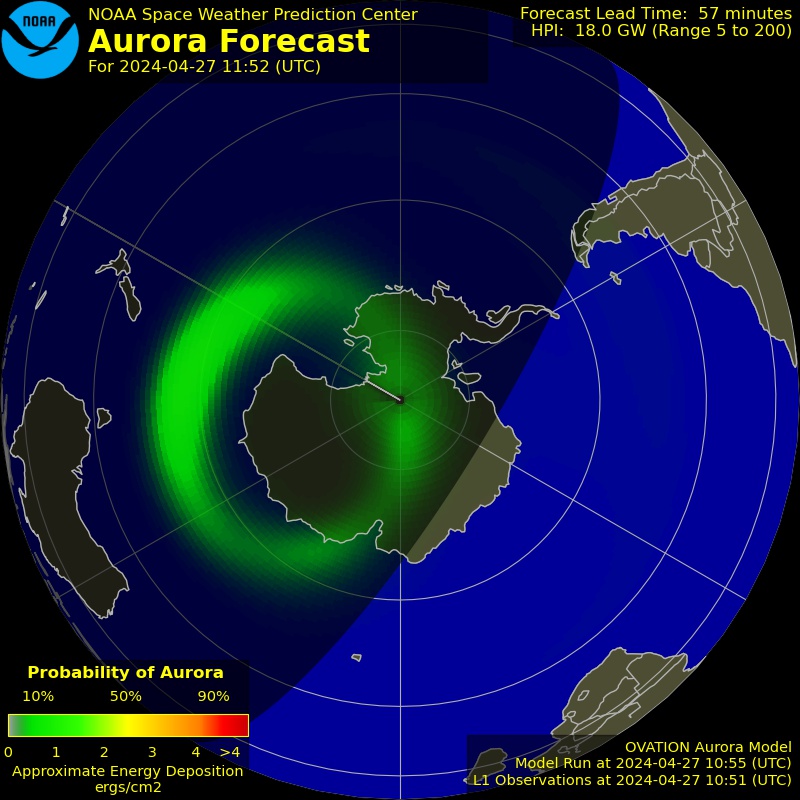
One of the largest sunspots in years, AR1944, has turned toward Earth and it is crackling with strong flares. On Jan. 7th (yesterday), the active region produced M7- and X1-class eruptions, and more appear to be in the offing. As this alert was being issued, analysts were waiting for more data from solar observatories to clarify the possibility of CME …

Read the rest of this article
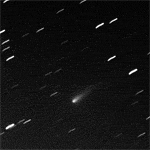
The countdown clock is ticking to comet ISON’s hair-raising passage around the sun on Nov. 28, as it grazes the sun at a distance of only 1.5 times the sun’s radius. Astronomers continue reworking estimates of how much of an impression the far visitor will make to Earthbound observers.

The prognostication is so chancy that I couldn’t even get comet-hunting …

Read the rest of this article

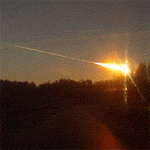
Just before midnight on Sept. 27-28, sky watchers in more than a dozen US states witnessed a bright flash of light. NASA all-sky cameras recorded a brilliant fireball, which analysts believe was a meter-class space rock exploding almost directly above Columbus, Ohio.

Witnesses reported shadows cast upon the ground, unusual sounds, and a swirling contrail marking the aftermath of the …

Read the rest of this article

In astronomy, there’s nothing quite like a bright meteor streaking across the glittering canopy of a moonless night sky. The unexpected flash of light adds a dash of magic to an ordinary walk under the stars.

New research by NASA has just identified the most magical nights of all.

“We have found that one meteor shower produces more fireballs than …

Read the rest of this article

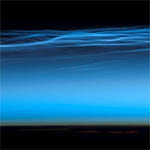
Every summer, something strange and wonderful happens high above the north pole. Ice crystals begin to cling to the smoky remains of meteors, forming electric-blue clouds with tendrils that ripple hypnotically against the sunset sky. Noctilucent clouds—a.k.a. “NLCs”–are a delight for high-latitude sky watchers, and around the Arctic Circle their season of visibility is always eagerly anticipated.

News flash: This …

Read the rest of this article

Anticipation is building as Comet ISON plunges into the inner solar system for a close encounter with the sun in November 2013. Blasted at point-blank range by solar radiation, the sungrazer will likely become one of the finest comets in many years.

When NASA’s Swift spacecraft observed the comet in January 2013, it was still near the orbit of Jupiter, …

Read the rest of this article
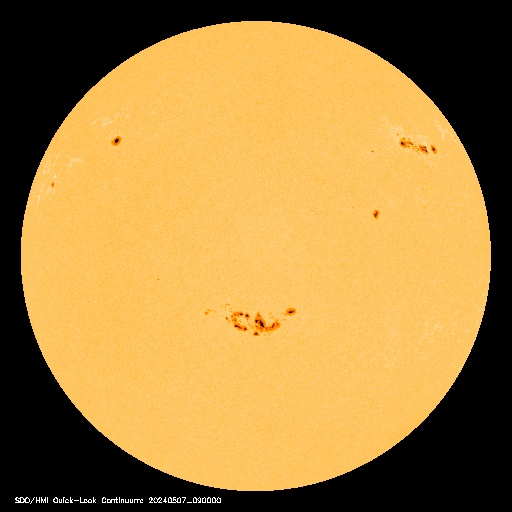
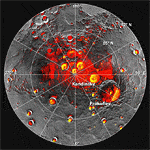
NASA has recently discovered a very strange planet. Its days are twice as long as its years. It has a tail like a comet. It is hot enough to melt lead, yet capped by deposits of ice. And to top it all off … it appears to be pink.

The planet is Mercury.

Of course, astronomers have known about Mercury …

Read the rest of this article
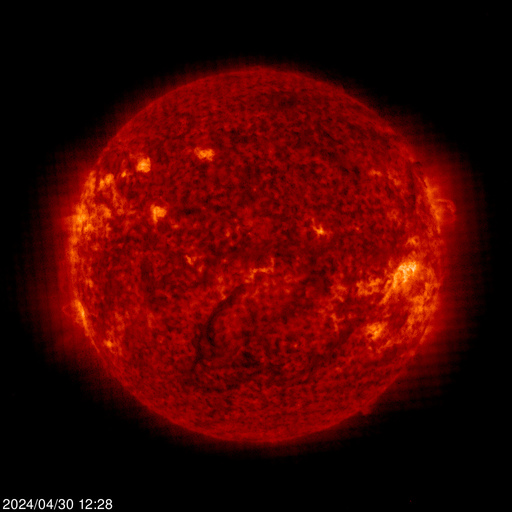
Out near the orbit of Jupiter, a faint speck of light is moving through the black of space. At first glance it doesn’t look like much, no brighter than a thousand distant stars speckling the velvet sky behind it; indeed, it takes a big telescope make out that it is a comet.

But what a comet it could turn out …

Read the rest of this article
The Perseids are the best-known of the year’s meteor showers, and are usually the most popular as the nights do not get as cold as the other major showers in the winter.


The Perseid meteor shower is underway. There’s more to see than meteors, however, when the shower peaks on August 11th through 13th. The brightest planets in the solar …

Read the rest of this article