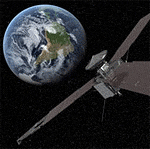
A mystery that has stumped scientists for decades might be one step closer to solution after ESA tracking stations carefully record signals from NASA’s Juno spacecraft as it swings by Earth today.

NASA’s deep-space probe will zip past to within 561 km at 19:21 GMT as it picks up a gravitational speed boost to help it reach Jupiter in 2016.…

Read the rest of this article
Deep-space missions require precise navigation, in particular when approaching bodies such as Mars, Venus or a comet. How precise?

It’s necessary to pinpoint a spacecraft 100 million kilometres from Earth to within 1 km. To achieve this level of accuracy, ESA experts use ‘quasars’ – the most luminous objects known in the Universe – as beacons in a technique known …

Read the rest of this article
This August sees the return of the Perseid meteor shower and, with the moon setting around midnight on Aug 11, the early hours of the 12th should allow for a fantastic show. But say if you’re clouded out?

The shower has been observed for around 2,000 years and the particles of dust making up the individual meteors we see today …

Read the rest of this article
Computer simulations by a pair of researchers at the University of Edinburgh predict that a fleet of interstellar probes could explore the entire Milky Way galaxy within a fraction of the present age of Earth. This may seem like a tall order considering that our farthest interstellar spacecraft, Voyager 1, is still less than a light-day from Earth after being …

Read the rest of this article
NASA’s Gravity Recovery And Interior Laboratory (GRAIL) spacecraft orbiting the moon officially have begun their science collection phase. During the next 84 days, scientists will obtain a high-resolution map of the lunar gravitational field to learn about the moon’s internal structure and composition in unprecedented detail. The data also will provide a better understanding of how Earth and other rocky …

Read the rest of this article

Twin NASA spacecraft that achieved orbit around the moon New Year’s Eve and New Year’s Day have new names, thanks to elementary students in Bozeman, Mont. Their winning entry, “Ebb and Flow,” was selected as part of a nationwide school contest that began in October 2011.


Using a precision formation-flying technique, the twin GRAIL spacecraft will map the moon’s gravity …

Read the rest of this article

The second of NASA’s two Gravity Recovery And Interior Laboratory (GRAIL) spacecraft has successfully completed its planned main engine burn and is now in lunar orbit. Working together, GRAIL-A and GRAIL-B will study the moon as never before.


Artist concept of GRAIL-B performing its lunar orbit insertion burn. Image credit: NASA/JPL-Caltech

“NASA greets the new year with a new mission …

Read the rest of this article

The first of two NASA spacecraft to study the moon in unprecedented detail has entered lunar orbit.

NASA’s Gravity Recovery And Interior Laboratory (GRAIL)-A spacecraft successfully completed its planned main engine burn at 2 p.m. PST (5 p.m. EST) today. As of 3 p.m. PST (6 p.m. EST), GRAIL-A is in an orbit of 56 miles by 5,197 miles (90 …

Read the rest of this article

No team of reindeer, but radio signals flying clear across the solar system from NASA’s Cassini spacecraft have delivered a holiday package of glorious images. The pictures, from Cassini’s imaging team, show Saturn’s largest, most colorful ornament, Titan, and other icy baubles in orbit around this splendid planet.


Titan and Dione: Saturn’s third-largest moon Dione can be seen through the …

Read the rest of this article

NASA’s Gravity Recovery And Interior Laboratory (GRAIL), mission to study the moon is in final launch preparations for a scheduled Sept. 8 launch onboard a Delta II rocket from Cape Canaveral Air Force Station in Florida.

GRAIL’s twin spacecraft are tasked for a nine-month mission to explore Earth’s nearest neighbor in unprecedented detail. They will determine the structure of the …

Read the rest of this article