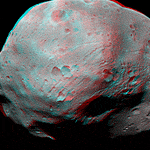
The innermost moon of Mars, Phobos, is seen here in full 360 degree glory. The images were taken by the High Resolution Stereo Camera (HRSC) on ESA’s Mars Express at various times throughout the mission’s 10 years.

The moon’s parallel sets of grooves are perhaps the most striking feature, along with the giant 9 km-wide Stickney impact crater that dominates …

Read the rest of this article

Curiosity Mars Rover

NASA’s Mars rover Curiosity has driven up to a football-size rock that will be the first for the rover’s arm to examine.

Curiosity is about 8 feet (2.5 meters) from the rock. It lies about halfway from the rover’s landing site, Bradbury Landing, to a location called Glenelg. In coming days, the team plans to touch the rock with a …

Read the rest of this article

Some 135 years after its discovery, Mars’ largest moon Phobos is seen in fantastic detail – and in 3D – in an image taken by ESA’s Mars Express spacecraft as it passed just 100 km by.


Mars Express HRSC (High Resolution Stereo Camera) image of Phobos taken on 9 January 2011 at a distance of 100 km with a resolution …

Read the rest of this article


This image of Phobos’s surface was obtained by the Super Resolution Channel (or SRC, a part of the High Resolution Stereo Camera experiment) on board ESA’s Mars Express on 3 August 2008 (orbit 5889). The distance from the moon’s centre was 656 km, and the image resolution is 6 m/pixel. The original image has been corrected for mirror distortion. Credits:

Read the rest of this article