Mars

On September 20th, NASA announced the opening of registration for its Mars Balance Mass Challenge and the launch of its new website, NASA Solve, at the World Maker Faire in New York.

NASA is committed to engaging the public, and specifically the maker community through innovative activities like the Mars Balance Mass Challenge,” said NASA Chief Technologist …

Read the rest of this article

For NASA and its dozens of missions, data pour in every day like rushing rivers. Spacecraft monitor everything from our home planet to faraway galaxies, beaming back images and information to Earth. All those digital records need to be stored, indexed and processed so that spacecraft engineers, scientists and people across the globe can use the data to understand Earth …

Read the rest of this article

NASA is seeking applications from U.S. graduate students for the agency’s Space Technology Research Fellowships. The research grants, worth as much as $68,000 per year, will coincide with the start of the 2014 fall term.

Applications will be accepted from students pursuing or planning to pursue master’s or doctorate degrees in relevant space technology disciplines at accredited U.S. universities. The …

Read the rest of this article

Insight Mars Mission

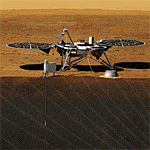
NASA has narrowed to four the number of potential landing sites for the agency’s next mission to the surface of Mars, a 2016 lander to study the planet’s interior.

The stationary Interior Exploration Using Seismic Investigations, Geodesy and Heat Transport (InSight) lander is scheduled to launch in March 2016 and land on Mars six months later. It will touch down …

Read the rest of this article

Like many of his colleagues at NASA’s Jet Propulsion Laboratory, Pasadena, Calif., Shyam Bhaskaran is working a lot with asteroids these days. And also like many of his colleagues, the deep space navigator devotes a great deal of time to crafting, and contemplating, computer-generated 3-D models of these intriguing nomads of the solar system.


This spectacular image of comet Tempel …

Read the rest of this article

NASA

NASA unveiled an Exploration Design Challenge on Monday to give students from kindergarten through 12th grade the opportunity to play a unique role in the future of human spaceflight. The innovative educational opportunity was announced in a special event at NASA’s Johnson Space Center in Houston.

The challenge asks students in the U.S. and abroad to think and act like …

Read the rest of this article

<iframe src="http://widgets.itunes.apple.com/appstore.html?wtype=0&app_id=541089908&country=us&partnerId=30&affiliate_id=http%3A%2F%2Fclick.linksynergy.com%2Ffs-bin%2Fstat%3Fid%3Dn2ojzX7Wk/A%26offerid%3D146261%26type%3D3%26subid%3D0%26tmpid%3D1826%26RD_PARM1%3D” frameborder=0 style=”overflow-x:hidden;overflow-y:hidden;width:250px;height:300px;border:0px” >

A NASA-created application that brings some of the agency’s robotic spacecraft to life in 3-D now is available for free on the iPhone and iPad.

Called Spacecraft 3D, the app uses animation to show how spacecraft can maneuver and manipulate their outside components. Presently, the new app features two NASA missions, …

Read the rest of this article

NASA

The NASA Innovative Advanced Concepts (NIAC) Program is seeking proposals to continue promising studies for which it has supported the first phase. These cutting-edge concepts have the potential to transform future exploration missions, enable new capabilities, or significantly alter current approaches to launching, building, and operating aerospace systems.

“These transformative concepts have the potential to mature into the new capabilities …

Read the rest of this article

NASA is extending three missions affiliated with the Jet Propulsion Laboratory in Pasadena, Calif. — Kepler, the Spitzer Space Telescope and the U.S. portion of the European Space Agency’s Planck mission — as a result of the 2012 Senior Review of Astrophysics Missions.


From left to right, artist’s concepts of the Spitzer, Planck and Kepler space telescopes. NASA extended Spitzer …

Read the rest of this article

The existence of a world with a double sunset, as portrayed in the film Star Wars more than 30 years ago, is now scientific fact. NASA’s Kepler mission has made the first unambiguous detection of a circumbinary planet — a planet orbiting two stars — 200 light-years from Earth.


An artist’s concept of Kepler-16b, the first planet known to definitively …

Read the rest of this article