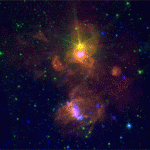
Massive stars are born in tumultuous clouds of gas and dust. They lead a brief but intense life, blowing powerful winds of particles and radiation that strike their surroundings, before their explosive demise as supernovas.

The interplay between massive stars and their environment is revealed in this image of the star-forming region ON2. It combines X-ray coverage from ESA’s XMM-Newton …

Read the rest of this article
In celebration of the 24th anniversary of the launch of NASA’s Hubble Space Telescope (on April 24, 1990) astronomers have taken an infrared-light portrait of a roiling region of starbirth located 6,400 light-years away.

The Hubble mosaic unveils a collection of carved knots of gas and dust in a small portion of the Monkey Head Nebula (also known as NGC …

Read the rest of this article
NASA is inviting the public to help astronomers discover embryonic planetary systems hidden among data from the agency’s Wide-field Infrared Survey Explorer (WISE) mission through a new website, DiskDetective.org.

Disk Detective is NASA’s largest crowdsourcing project whose primary goal is to produce publishable scientific results. It exemplifies a new commitment to crowdsourcing and open data by the United States government.…

Read the rest of this article

 
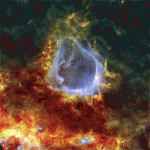
Nestled within the shell around this large bubble is an embryonic star that is already a hefty eight times more massive than our Sun.

This image, by ESA’s Herschel space observatory, was originally presented in the first announcement of scientific results  from the mission in May 2010.

This week Herschel scientists will meet again at ESA’s ESTEC establishment in the …

Read the rest of this article

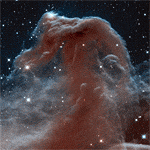
New views of the Horsehead Nebula and its turbulent environment have been unveiled by ESA’s Herschel space observatory and the NASA/ESA Hubble space telescope.


Stunning new view from ESA’s Herschel space observatory of the iconic Horsehead Nebula in the context of its surroundings. The image is a composite of the wavelengths of 70 microns (blue), 160 microns (green) and 250 …

Read the rest of this article

A star thought to have passed the age at which it can form planets may, in fact, be creating new worlds. The disk of material surrounding the surprising star called TW Hydrae may be massive enough to make even more planets than we have in our own solar system.


This artist’s concept illustrates an icy planet-forming disk around a young …

Read the rest of this article


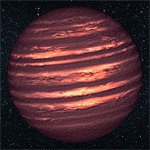
This artist’s conception illustrates the brown dwarf named 2MASSJ22282889-431026. NASA’s Hubble and Spitzer space telescopes observed the object to learn more about its turbulent atmosphere. Brown dwarfs are more massive and hotter than planets but lack the mass required to become sizzling stars. Their atmospheres can be similar to the giant planet Jupiter’s. Spitzer and Hubble simultaneously observed the object …

Read the rest of this article
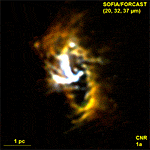
Researchers using the Stratospheric Observatory for Infrared Astronomy (SOFIA) have captured new images of a ring of gas and dust seven light-years in diameter surrounding the supermassive black hole at the center of the Milky Way, and of a neighboring cluster of extremely luminous young stars embedded in dust cocoons.


SOFIA/FORCAST mid-infrared image of the Milky Way galaxy’s nucleus showing …

Read the rest of this article
The faint, lumpy glow given off by the very first objects in the universe may have been detected with the best precision yet, using NASA’s Spitzer Space Telescope. These faint objects might be wildly massive stars or voracious black holes. They are too far away to be seen individually, but Spitzer has captured new, convincing evidence of what appears to …

Read the rest of this article
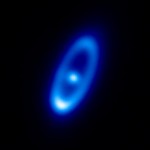
ESA’s Herschel Space Observatory has studied the dusty belt around the nearby star Fomalhaut. The dust appears to be coming from collisions that destroy up to thousands of icy comets every day.


Herschel’s image of Fomalhaut

Fomalhaut is a young star, just a few hundred million years old, and twice as massive as the Sun. Its dust belt was discovered …

Read the rest of this article