COMET C-2014 UN271 NUCLEUS

NASA’s Hubble Space Telescope has determined the size of the largest icy comet nucleus ever seen by astronomers.

The estimated diameter is approximately 80 miles (120 km) across, making it larger than the state of Rhode Island.

The nucleus is about 50 times larger than found at the heart of most known comets.

Its mass is estimated to be a …

Read the rest of this article

Earendel - The Most Distant Star Ever Seen

The NASA/ESA Hubble Space Telescope has established an extraordinary new benchmark: detecting the light of a star that existed within the first billion years after the Universe’s birth in the Big Bang (at a redshift of 6.2) — the most distant individual star ever seen.

This sets up a major target for the NASA/ESA/CSA James Webb Space Telescope in its …

Read the rest of this article

James Webb Space Telescope

The James Webb Space Telescope is undergoing final integration and testing that will require more time to ensure a successful mission. Following a new assessment of the remaining tasks on the highly complex space observatory, the launch window is now targeted for about May 2020.

The James Webb Space Telescope (JWST) is a daring endeavour and we need to

Read the rest of this article

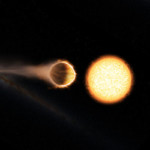
This artist's concept shows hot Jupiter WASP-121b

Scientists have discovered the strongest evidence to date for a stratosphere on a planet outside our solar system, or exoplanet. A stratosphere is a layer of atmosphere in which temperature increases with higher altitudes.

This result is exciting because it shows that a common trait of most of the atmospheres in our solar system — a warm stratosphere —

Read the rest of this article

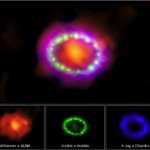
Three decades ago, astronomers spotted one of the brightest exploding stars in more than 400 years. The titanic supernova, called Supernova 1987A (SN 1987A), blazed with the power of 100 million suns for several months following its discovery on Feb. 23, 1987.


This is where Supernova 1987A is located

Since that first sighting, SN 1987A has continued to fascinate astronomers …

Read the rest of this article

Jupiter's Moon, Ganymede

In the video below, scientists Tony Darnell, Dr. Carol Christian and Scott Lewis discuss observations of Ganymede with the Hubble Space Telescope science team.

Nearly 500 million miles from the Sun lies a moon orbiting Jupiter that is slightly larger than the planet Mercury and may contain more water than all of Earth’s oceans. Temperatures are so cold, though, that …

Read the rest of this article

Hubble Reveals Observable Universe Contains 10 Times More Galaxies Than Previously Thought

The universe suddenly looks a lot more crowded, thanks to a deep-sky census assembled from surveys taken by NASA’s Hubble Space Telescope and other observatories.

Astronomers came to the surprising conclusion that there are at least 10 times more galaxies in the observable universe than previously thought.

The results have clear implications for galaxy formation, and also helps shed light …

Read the rest of this article

Artist's Illustration of Scenario for Plasma Ejections from V Hydrae

Great balls of fire! NASA’s Hubble Space Telescope has detected superhot blobs of gas, each twice as massive as the planet Mars, being ejected near a dying star. The plasma balls are zooming so fast through space it would take only 30 minutes for them to travel from Earth to the moon. This stellar “cannon fire” has continued once every …

Read the rest of this article

Most Distant Galaxy Seen Yet

By pushing NASA’s Hubble Space Telescope to its limits, an international team of astronomers has shattered the cosmic distance record by measuring the farthest galaxy ever seen in the universe. This surprisingly bright, infant galaxy, named GN-z11, is seen as it was 13.4 billion years in the past, just 400 million years after the big bang. GN-z11 is located in …

Read the rest of this article

New Hubble Image of Jupiter's Great Red Spot

Scientists using NASA’s Hubble Space Telescope have produced new maps of Jupiter — the first in a series of annual portraits of the solar system’s outer planets.

Collecting these yearly images — essentially the planetary version of annual school picture days for children — will help current and future scientists see how these giant worlds change over time. The observations …

Read the rest of this article