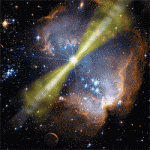
The electromagnetic spectrum is vast, ranging from high-energy gamma rays all the way to low-energy radio waves. Different telescopes and instruments are optimised to detect different regions of this spectrum — for example, ESA’s XMM-Newton and Integral space observatories study the high-energy Universe, scouring the skies for X-rays and gamma rays.

One cosmic source of such high-energy radiation is the …

Read the rest of this article
NASA successfully beamed a high-definition video 260 miles from the International Space Station to Earth Thursday using a new laser communications instrument.

Transmission of “Hello, World!” as a video message was the first 175-megabit communication for the Optical Payload for Lasercomm Science (OPALS), a technology demonstration that allows NASA to test methods for communication with future spacecraft using higher bandwidth …

Read the rest of this article

A new exhibit steeped in the cinematic world of “The Avengers” provides a super-powered dose of science and technology from NASA. The unique, interactive educational display premiered at Discovery Times Square in New York City on May 30, 2014, for a six-month engagement.

Marvel’s Avengers S.T.A.T.I.O.N. — an acronym for Scientific Training and Tactical Intelligence Operative Network — is an …

Read the rest of this article

Astronomers have found some of the youngest stars ever seen, thanks to the Herschel space observatory, a European Space Agency mission with important NASA contributions.

Observations from NASA’s Spitzer Space Telescope and the Atacama Pathfinder Experiment (APEX) telescope in Chile, a collaboration involving the Max Planck Institute for Radio Astronomy in Germany, the Onsala Space Observatory in Sweden, and the …

Read the rest of this article
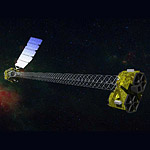

This new view of spiral galaxy IC 342, also known as Caldwell 5, includes data from NASA’s Nuclear Spectroscopic Telescope Array, or NuSTAR. High-energy X-ray data from NuSTAR have been translated to the color magenta, and superimposed on a visible-light view highlighting the galaxy and its star-studded arms. NuSTAR is the first orbiting telescope to take focused pictures of the …

Read the rest of this article
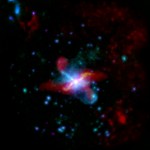
Two of ESA’s space observatories have combined to create a multi-wavelength view of violent events taking place within the giant galaxy of Centaurus A. The new observations strengthen the view that it may have been created by the cataclysmic collision of two older galaxies.


The peculiar galaxy Centaurus A in the far-infrared and X-rays. Inner structural features seen in this …

Read the rest of this article

The human eye is crucial to astronomy. Without the ability to see, the luminous universe of stars, planets and galaxies would be closed to us, unknown forever. Nevertheless, astronomers cannot shake their fascination with the invisible.

Outside the realm of human vision is an entire electromagnetic spectrum of wonders. Each type of light–­from radio waves to gamma-rays–reveals something unique about …

Read the rest of this article

In 1995, the Hubble Space Telescope’s ‘Pillars of Creation’ image of the Eagle Nebula became one of the most iconic images of the 20th century. Now, two of ESA’s orbiting observatories have shed new light on this enigmatic star-forming region.


Combining almost opposite ends of the electromagnetic spectrum, this composite of the Herschel in far-infrared and XMM-Newton’s X-ray images shows …

Read the rest of this article

A New Kind of Pulsar

About three times a second, a 10,000-year-old stellar corpse sweeps a beam of gamma-rays toward Earth. Just discovered by NASA’s Fermi Gamma-ray Space Telescope, the object, called a pulsar, is the first one known that “blinks” in pure gamma rays.


An artist’s concept of the newly discovered pulsar. Clouds of charged particles move along the pulsar’s magnetic field lines (blue)

Read the rest of this article
NASA has made a decision to restart an astronomy mission that will have greater capability than any existing instrument for detecting black holes in the local universe.

The Nuclear Spectroscopic Telescope Array, or NuSTAR, will expand our understanding of the origins and destinies of stars and galaxies. NASA had stopped the study effort on the NuSTAR mission in 2006 due …

Read the rest of this article