Astronomers tinkering with ice and organics in the lab may have discovered why comets are encased in a hard, outer crust.

Using an icebox-like instrument nicknamed Himalaya, the researchers show that fluffy ice on the surface of a comet would crystalize and harden as the comet heads toward the sun and warms up. As the water-ice crystals form, becoming denser …

Read the rest of this article
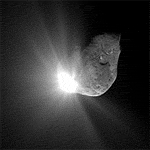
After almost 9 years in space that included an unprecedented July 4th impact and subsequent flyby of a comet, an additional comet flyby, and the return of approximately 500,000 images of celestial objects, NASA’s Deep Impact mission has ended.

The project team at NASA’s Jet Propulsion Laboratory in Pasadena, Calif., has reluctantly pronounced the mission at an end after being …

Read the rest of this article
Ten years after a Delta II rocket launched NASA’s Spitzer Space Telescope, lighting up the night sky over Cape Canaveral, Fla., the fourth of the agency’s four Great Observatories continues to illuminate the dark side of the cosmos with its infrared eyes.

The telescope studied comets and asteroids, counted stars, scrutinized planets and galaxies, and discovered soccer-ball-shaped carbon spheres in …

Read the rest of this article
Astronomers using NASA’s Spitzer Space Telescope have observed what most likely are strong carbon dioxide emissions from Comet ISON ahead of its anticipated pass through the inner solar system later this year.

Images captured June 13 with Spitzer’s Infrared Array Camera indicate carbon dioxide is slowly and steadily “fizzing” away from the so-called “soda-pop comet,” along with dust, in a …

Read the rest of this article
Like many of his colleagues at NASA’s Jet Propulsion Laboratory, Pasadena, Calif., Shyam Bhaskaran is working a lot with asteroids these days. And also like many of his colleagues, the deep space navigator devotes a great deal of time to crafting, and contemplating, computer-generated 3-D models of these intriguing nomads of the solar system.


This spectacular image of comet Tempel …

Read the rest of this article
NASA’s Deep Impact spacecraft has acquired its first images of comet C/2012 S1 (ISON). The images were taken by the spacecraft’s Medium-Resolution Imager over a 36-hour period on Jan. 17 and 18, 2013, from a distance of 493 million miles (793 million kilometers). Many scientists anticipate a bright future for comet ISON; the spaceborne conglomeration of dust and ice may …

Read the rest of this article

NASA’s Stardust spacecraft returned new images of a comet showing a scar resulting from the 2005 Deep Impact mission. The images also showed the comet has a fragile and weak nucleus.

The spacecraft made its closest approach to comet Tempel 1 on Monday, Feb. 14, at 8:40 p.m. PST (11:40 p.m. EST) at a distance of approximately 178 kilometers (111 …

Read the rest of this article

NASA is about to discover how solar heat devours a comet.


Stardust-NExT chases a comet, an artist’s concept. [more]

“For the first time, we’ll see the same comet before and after its closest approach to the sun,” explains Joe Veverka, principal investigator for NASA’s Stardust-NExT mission.

The comet is Tempel 1, which NASA’s Deep Impact probe visited in …

Read the rest of this article

NASA’s Deep Impact (EPOXI) probe is closing in on Comet Hartley 2 for a daring flyby today (Nov. 4th).

The small but active comet is full of surprises, with spinning jets, geysers of cyanide gas, and a strangely pickle-shaped core. Mission scientists expect to reveal first images from the flyby during a press conference on Thursday afternoon, around 4 pm …

Read the rest of this article

As NASA’s Deep Impact (EPOXI) probe approaches Comet Hartley 2 for a close encounter on Nov. 4th, mission scientists are certain of only one thing:

“We’re about to be surprised,” says principal investigator Mike A’Hearn of the University of Maryland. “This comet is unlike any we’ve visited before, and we don’t know what we’re going to find.”


Newly-discovered jets spin

Read the rest of this article