COMET C-2014 UN271 NUCLEUS

NASA’s Hubble Space Telescope has determined the size of the largest icy comet nucleus ever seen by astronomers.

The estimated diameter is approximately 80 miles (120 km) across, making it larger than the state of Rhode Island.

The nucleus is about 50 times larger than found at the heart of most known comets.

Its mass is estimated to be a …

Read the rest of this article

Philae Lander

One year since Philae made its historic landing on a comet, mission teams remain hopeful for renewed contact with the lander, while also looking ahead to next year’s grand finale: making a controlled impact of the Rosetta orbiter on the comet.

Rosetta arrived at Comet 67P/Churyumov–Gerasimenko on 6 August 2014, and after an initial survey and selection of a landing …

Read the rest of this article

Probe Will Assist Agency in Search for Candidates to Explore

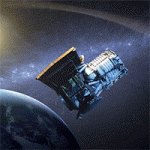
NASA’s Near-Earth Object Wide-field Infrared Survey Explorer (NEOWISE), a spacecraft that made the most comprehensive survey to date of asteroids and comets, has returned its first set of test images in preparation for a renewed mission.

NEOWISE discovered more than 34,000 asteroids and characterized 158,000 throughout the solar system during …

Read the rest of this article

Comets and other icy celestial bodies have some basic building blocks for life, but it takes violent impacts to take them to the next level, according to researchers who claim to have successfully created amino acids in the lab by recreating icy interplanetary collisions.

First the researchers created mixtures of water ice and light organic chemicals roughly based on what …

Read the rest of this article

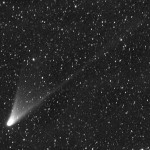
Later this year, Comet ISON is expected to become a naked-eye object when it skims through the atmosphere of the sun. The Hubble Space Telescope has just obtained a sneak preview.

Hubble photographed ISON on April 10th. At the time, the comet was 386 million miles from the sun (394 million miles from Earth), just inside the orbit of Jupiter. …

Read the rest of this article

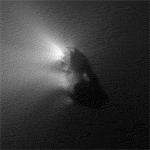
Comet Halley, the originator of the Orionids meteor shower that lit up our skies last month – as they do every October – is seen here up close by ESA’s Giotto probe as it flew past the famous comet on 13–14 March 1986.


Comet Halley as seen by ESA’s Giotto spacecraft in 1986, the last time the comet visited the …

Read the rest of this article

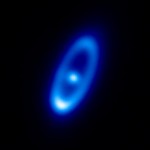
ESA’s Herschel Space Observatory has studied the dusty belt around the nearby star Fomalhaut. The dust appears to be coming from collisions that destroy up to thousands of icy comets every day.


Herschel’s image of Fomalhaut

Fomalhaut is a young star, just a few hundred million years old, and twice as massive as the Sun. Its dust belt was discovered …

Read the rest of this article

ESA’s Herschel space observatory has found evidence of water vapour emanating from ice on dust grains in the disc around a young star, revealing a hidden ice reservoir the size of thousands of oceans.


This image shows an artist’s impression of the icy protoplanetary disc around the young star TW Hydrae (upper panel) and the spectrum of the disc as …

Read the rest of this article

ESA’s Herschel infrared space observatory has found water in a comet with almost exactly the same composition as Earth’s oceans. The discovery revives the idea that our planet’s seas could once have been giant icebergs floating through space.


This illustration shows the orbit of comet Hartley 2 in relation to those of the five innermost planets of the Solar System. …

Read the rest of this article

The sun has just experienced a storm—not of explosive flares and hot plasma, but of icy comets.

“The storm began on Dec 13th and ended on the 22nd,” says Karl Battams of the Naval Research Lab in Washington, DC. “During that time, the Solar and Heliospheric Observatory (SOHO) detected 25 comets diving into the sun. It was crazy!”

Sundiving comets—a.k.a. …

Read the rest of this article