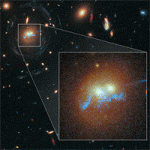
Astronomers routinely use the crisp view of NASA’s Hubble Space Telescope to study all kinds of intricate details in galaxy clusters. By now you would think they’ve seen it all — but nature always has new surprises in store.

The latest is an uncanny 100,000-light-year-long structure that looks like a string of pearls twisted into a corkscrew shape that winds …

Read the rest of this article
ESA’s Herschel space observatory has discovered an extremely distant galaxy making stars more than 2000 times faster than our own Milky Way. Seen at a time when the Universe was less than a billion years old, its mere existence challenges our theories of galaxy evolution.


Artist’s impression of starburst galaxy HFLS3. The galaxy appears as little more than a faint, …

Read the rest of this article

Supernova explosions and the jets of a monstrous black hole are scattering a galaxy’s star-making gas like a cosmic leaf blower, a new study finds. The findings, which relied on ultraviolet observations from NASA’s Galaxy Evolution Explorer and a host of other instruments, fill an important gap in the current understanding of galactic evolution.


Time is running out for the …

Read the rest of this article

ESA’s Planck mission has revealed that our Galaxy contains previously undiscovered islands of cold gas and a mysterious haze of microwaves. These results give scientists new treasure to mine and take them closer to revealing the blueprint of cosmic structure.


This all-sky image shows the distribution of carbon monoxide (CO), a molecule used by astronomers to trace molecular clouds across …

Read the rest of this article

New observations from the Herschel Space Observatory show a bizarre, twisted ring of dense gas at the center of our Milky Way galaxy. Only a few portions of the ring, which stretches across more than 600 light-years, were known before. Herschel’s view reveals the entire ring for the first time, and a strange kink that has astronomers scratching their heads.…

Read the rest of this article