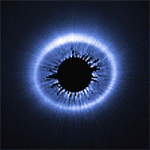
Stellar Debris Disk

A NASA-sponsored website designed to crowdsource analysis of data from the agency’s Wide-field Infrared Survey Explorer (WISE) mission has reached an impressive milestone. In less than a year, citizen scientists using DiskDetective.org have logged 1 million classifications of potential debris disks and disks surrounding young stellar objects (YSO). This data will help provide a crucial set of targets for future …

Read the rest of this article
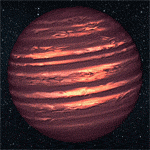
Swirling, stormy clouds may be ever-present on cool celestial orbs called brown dwarfs. New observations from NASA’s Spitzer Space Telescope suggest that most brown dwarfs are roiling with one or more planet-size storms akin to Jupiter’s “Great Red Spot.”

“As the brown dwarfs spin on their axis, the alternation of what we think are cloud-free and cloudy regions produces a …

Read the rest of this article

Planets rich in carbon, including so-called diamond planets, may lack oceans, according to NASA-funded theoretical research.

Our sun is a carbon-poor star, and as result, our planet Earth is made up largely of silicates, not carbon. Stars with much more carbon than the sun, on the other hand, are predicted to make planets chock full of carbon, and perhaps even …

Read the rest of this article

Using NASA’s Hubble Space Telescope, astronomers have uncovered a cluster of galaxies in the initial stages of development. It is the most distant such grouping ever observed in the early universe.

In a random sky survey made in near-infrared light, Hubble found five tiny galaxies clustered together 13.1 billion light-years away. They are among the brightest galaxies at that epoch …

Read the rest of this article

After 16 years in space, NASA’s Rossi X-ray Timing Explorer (RXTE) has made its last observation. The satellite provided unprecedented views into the extreme environments around white dwarfs, neutron stars and black holes.

RXTE sent data from its last science observation to the ground early on Jan. 4. After performing engineering tests, controllers at NASA’s Goddard Space Flight Center in …

Read the rest of this article

NASA’s Hubble Space Telescope has found a rare class of oddball stars called blue stragglers in the hub of our Milky Way, the first detected within our galaxy’s bulge.


‘Hubble Finds Blue Straggler Stars in the Galactic Bulge. Source: Hubblesite.org

Blue stragglers are so named because they seemingly lag behind in the aging process, appearing younger than the population from …

Read the rest of this article

Scientists using NASA’s Fermi Gamma-ray Space Telescope have detected beams of antimatter produced above thunderstorms on Earth, a phenomenon never seen before.

Scientists think the antimatter particles were formed inside thunderstorms in a terrestrial gamma-ray flash (TGF) associated with lightning. It is estimated that about 500 TGFs occur daily worldwide, but most go undetected.

“These signals are the first direct …

Read the rest of this article

AAVSO AAVSO Alert Notice 420:
Nova in Sagittarius (V5586 Sgr = Nova Sgr 2010 No. 2)
April 26, 2010

Event: Nova in Sagittarius (V5586 Sgr = Nova Sgr 2010 No. 2)

Discovered By: Koichi Nishiyama, Kurume, Japan, and Fujio Kabashima, Miyaki, Japan

Discovery Date: Apr. 23.782 UT using a 105-mm f/4 camera lens (+ SBIG STL6303E camera)

Discovery Magnitude: unfiltered CCD …

Read the rest of this article

NASA’s Kepler space telescope, designed to find Earth-size planets in the habitable zone of sun-like stars, has discovered its first five new exoplanets, or planets beyond our solar system.

Kepler’s high sensitivity to both small and large planets enabled the discovery of the exoplanets, named Kepler 4b, 5b, 6b, 7b and 8b. The discoveries were announced Monday, Jan. 4, by …

Read the rest of this article