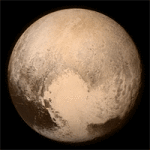
Closeup of Pluto

NASA’s New Horizons spacecraft is at Pluto.

After a decade-long journey through our solar system, New Horizons made its closest approach to Pluto Tuesday, about 7,750 miles above the surface — roughly the same distance from New York to Mumbai, India – making it the first-ever space mission to explore a world so far from Earth.

I’m delighted at

Read the rest of this article

NASA’s New Horizons mission reached a special milestone yesterday, Dec. 2, 2011, on its way to reconnoiter the Pluto system, coming closer to Pluto than any other spacecraft.

It’s taken New Horizons 2,143 days of high-speed flight – covering more than a million kilometers per day for nearly six years—to break the closest-approach mark of 1.58 billion kilometers set by …

Read the rest of this article

The NASA/ESA Hubble Space Telescope has discovered a new moon circling Pluto. P4, as it is currently called, is the smallest moon yet found orbiting Pluto, with an estimated size of 13–34 km. By comparison, Pluto’s largest moon, Charon, is 1043 km across, while Nix and Hydra are 32–113 km wide. The tiny, new satellite popped up in a Hubble …

Read the rest of this article

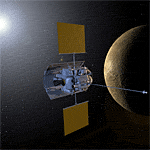
On Monday, Jan. 14, a pioneering NASA spacecraft was the first to visit Mercury in almost 33 years when it soared over the planet to explore and snap close-up images of never-before-seen terrain. These findings could open new theories and answer old questions in the study of the solar system.

The MErcury Surface, Space ENvironment, GEochemistry, and Ranging spacecraft, called …

Read the rest of this article

Astronomers have announced the discovery of a fifth planet circling 55 Cancri, a star beyond our solar system. The star now holds the record for number of confirmed extrasolar planets orbiting around it in a planetary system.

55 Cancri is located 41 light-years away in the constellation Cancer and has nearly the same mass and age as our sun. It …

Read the rest of this article
NASA has made a decision to restart an astronomy mission that will have greater capability than any existing instrument for detecting black holes in the local universe.

The Nuclear Spectroscopic Telescope Array, or NuSTAR, will expand our understanding of the origins and destinies of stars and galaxies. NASA had stopped the study effort on the NuSTAR mission in 2006 due …

Read the rest of this article
Two months after sky-darkening dust from severe storms nearly killed NASA’s Mars exploration rovers, the solar-powered robots are awake and ready to continue their mission. Opportunity’s planned descent into the giant Victoria Crater was delayed, but now the rover is preparing to drive into the half-mile diameter crater as early as Sept. 11.

Spirit, Opportunity’s rover twin, also survived the …

Read the rest of this article
Having explored Mars for three-and-a-half years in what were missions originally designed for three months, NASA’s Mars rovers are facing perhaps their biggest challenge.

For nearly a month, a series of severe Martian summer dust storms has affected the rover Opportunity and, to a lesser extent, its companion, Spirit. The dust in the Martian atmosphere over Opportunity has blocked 99 …

Read the rest of this article

Two NASA spacecraft now have new assignments after successfully completing their missions. The duo will make new observations of comets and characterize extrasolar planets. Stardust and Deep Impact will use their flight-proven hardware to perform new, previously unplanned, investigations.

“These mission extensions are as exciting as it gets. They will allow us to revisit a comet for the first time, …

Read the rest of this article

Today NASA released stunning new images of Jupiter and its moons taken by the New Horizons spacecraft. Views include a movie of a volcanic eruption on Jupiter’s moon Io; a nighttime shot of auroras and lava on Io; a color photo of the “Little Red Spot” churning in Jupiter’s cloudtops; images of small moons herding dust and boulders through Jupiter’s …

Read the rest of this article