Astronomers have used NASA’s Chandra X-ray Observatory and the European Space Agency’s (ESA’s) XMM-Newton to show a supermassive black hole six billion light years from Earth is spinning extremely rapidly. This first direct measurement of the spin of such a distant black hole is an important advance for understanding how black holes grow over time.

Black holes are defined by …

Read the rest of this article

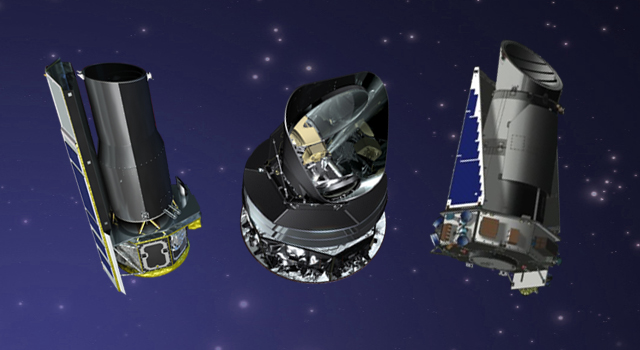
Exactly five years ago, on March 6, 2009, NASA’s Kepler Space Telescope rocketed into the night skies above Cape Canaveral Air Force Station in Florida to find planets around other stars, called exoplanets, in search of potentially habitable worlds.

Since then, Kepler has unveiled a whole new side of our galaxy — one that is teeming with planets. Because of …

Read the rest of this article

The following statement is from NASA Administrator Charles Bolden, released March 4 2014, on the Obama Administration’s budget request for the 2015 fiscal year:

“Today, President Obama released his Fiscal Year 2015 budget request for the nation, and there is a lot of good news in it for NASA. The president’s funding plan for America’s space program reaffirms the path …

Read the rest of this article

Our spiral-shaped Milky Way galaxy lives in a comparatively quiet backwater region of the universe. This is not the case for galaxies crammed together inside huge clusters. As they zip around within a cluster, gas can be pulled from their disks due to a process called ram pressure stripping. Galaxy ESO 137-001 is one example. The star-city looks like it …

Read the rest of this article

The billowing clouds portrayed in this image from ESA’s Herschel observatory are part of NGC 7538, a stellar nursery for massive stars. Located around 9000 light-years away, this is one of the few regions of massive-star formation that are relatively close to us, allowing astronomers to investigate this process in great detail.

Star factories like NGC 7538 consist mainly of …

Read the rest of this article

NASA’s Near-Earth Object Wide-field Infrared Survey Explorer (NEOWISE) spacecraft has spotted a never-before-seen comet — its first such discovery since coming out of hibernation late last year.

“We are so pleased to have discovered this frozen visitor from the outermost reaches of our solar system,” said Amy Mainzer, the mission’s principal investigator from NASA’s Jet Propulsion Laboratory in Pasadena, Calif. …

Read the rest of this article

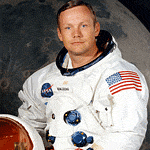
Two generations of aerospace engineering excellence will come together Saturday, March 1 when NASA’s Dryden Flight Research Center in Edwards, Calif., is redesignated NASA’s Armstrong Flight Research Center.

The agency’s center of excellence for atmospheric flight research is being renamed in honor of the late Neil A. Armstrong, a former research test pilot at the center and the first man …

Read the rest of this article

The Planet Mars

A team of scientists at NASA’s Johnson Space Center in Houston and the Jet Propulsion Laboratory in Pasadena, Calif., has found evidence of past water movement throughout a Martian meteorite, reviving debate in the scientific community over life on Mars.

In 1996, a group of scientists at Johnson led by David McKay, Everett Gibson and Kathie Thomas-Keprta published an article …

Read the rest of this article

The closest supernova of its kind to be observed in the last few decades has sparked a global observing campaign involving legions of instruments on the ground and in space, including NASA’s Spitzer Space Telescope. With its dust-piercing infrared vision, Spitzer brings an important perspective to this effort by peering directly into the heart of the aftermath of the stellar …

Read the rest of this article

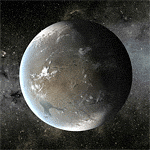
NASA’s Kepler mission announced Wednesday the discovery of 715 new planets. These newly-verified worlds orbit 305 stars, revealing multiple-planet systems much like our own solar system.

Nearly 95 percent of these planets are smaller than Neptune, which is almost four times the size of Earth. This discovery marks a significant increase in the number of known small-sized planets more akin …

Read the rest of this article