Opportunity Mars Rover

After avoiding use of the rover’s flash memory for three months, the team operating NASA’s 11-year-old Mars Exploration Rover Opportunity has reformatted the vehicle’s flash memory banks and resumed storing some data overnight for transmitting later.

The team received confirmation from Mars on March 20 that the reformatting completed successfully. The rover switched to updated software earlier this month that …

Read the rest of this article

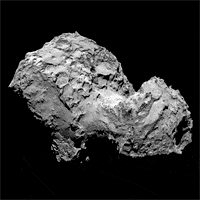
ESA’s Rosetta spacecraft has made the first measurement of molecular nitrogen at a comet, providing clues about the temperature environment in which Comet 67P/Churyumov–Gerasimenko formed.

Rosetta arrived last August, and has since been collecting extensive data on the comet and its environment with its suite of 11 science instruments.

The in situ detection of molecular nitrogen has long been sought …

Read the rest of this article

As today’s partial solar eclipse crossed Europe, it was also visible from space. ESA’s Proba-2 captured a near-total eclipse from orbit, at the same time as its sister minisatellite Proba-V peered down to snap the shadow of the eclipse on Earth.

ESA astronaut Samantha Cristoforetti also found time while running an experiment to record the eclipse from the International Space …

Read the rest of this article

AAVSO AAVSO Alert Notice 513
Request for observations of GW Lib in support of HST observations
March 18, 2015

Dr. Paula Szkody, University of Washington, has requested our help in monitoring the cataclysmic variable GW Lib for upcoming Hubble Space Telescope observations, scheduled to be made during the window 2015 April 22-25 UT. Dr. Szkody also observed this object with HST …

Read the rest of this article

This snapshot of our constantly changing Sun catches looping filaments and energetic eruptions on their outward journey from our star’s turbulent surface.

The disc of our star is a rippling mass of bright, hot active areas, interspersed with dark, cool snaking filaments that wrap around the star. Surrounding the tumultuous solar surface is the chaotic corona, a rarified atmosphere of …

Read the rest of this article

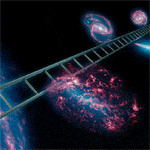
Astronomers at the Space Telescope Science Institute and the Johns Hopkins University, both in Baltimore, Maryland, have created a new master catalog of astronomical objects called the Hubble Source Catalog. The catalog provides one-stop shopping for measurements of objects observed with NASA’s Hubble Space Telescope.

Hubble has amassed a rich legacy of images and other scientific data over its 25 …

Read the rest of this article

AAVSO AAVSO Alert Notice 511
Monitoring requested for developing planetary systems dust production study
March 14, 2015

Dr. George Rieke (University of Arizona) and colleagues have requested AAVSO assistance in monitoring four stars with developing planetary systems. The targets are RZ Psc, HD 15407A, V488 Per, and HD 23514. This campaign is similar to the one conducted in 2013 (see AAVSO

Read the rest of this article

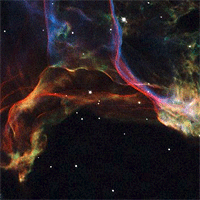
The Veil Nebula

Discovered on 5 September 1784 by astronomer William Herschel, the Veil Nebula was once a star. Now it is a twisted mass of shock waves that appears six times larger than the full Moon in the sky.

This Hubble Space Telescope image shows just a small part of the nebula, a region known as the ‘south-eastern knot’. The entire nebula …

Read the rest of this article

International Space Apps Challenge

NASA and other space agencies around the world are preparing for the fourth annual International Space Apps Challenge, which will be held April 10-12 at more than 135 locations worldwide, including New York, host of the event’s Global Mainstage.

During this three-day code-a-thon, participants are asked to develop mobile applications, software, hardware, data visualization and platform solutions that could contribute …

Read the rest of this article

Asteroid Ceres

NASA’s Dawn spacecraft has become the first mission to achieve orbit around a dwarf planet. The spacecraft was approximately 38,000 miles (61,000) kilometers from Ceres when it was captured by the dwarf planet’s gravity at about 4:39 a.m. PST (7:39 a.m. EST) Friday.

Mission controllers at NASA’s Jet Propulsion Laboratory (JPL) in Pasadena, California received a signal from the spacecraft …

Read the rest of this article