New Horizons Pluto Flyby

NASA is inviting media to cover New Horizons’ historic Pluto flyby in mid-July, including the spacecraft’s closest approach to Pluto on July 14, from the Johns Hopkins University Applied Physics Laboratory (APL) in Laurel, Maryland, site of the mission operations center.

Media who wish to cover the events at APL must receive accreditation from the APL Public Affairs Office by …

Read the rest of this article

Exoplanets

Researchers using NASA’s Hubble Space Telescope have detected a stratosphere and temperature inversion in the atmosphere of a planet several times the mass of Jupiter, called WASP-33b.

Earth’s stratosphere sits above the troposphere, the turbulent, active-weather region that reaches from the ground to the altitude where nearly all clouds top out. In the troposphere, the temperature is warmer at the …

Read the rest of this article

RoboSimian

Showing off its robustness and versatility, the ape-like RoboSimian robot, developed at NASA’s Jet Propulsion Laboratory, Pasadena, California, took fifth place in the DARPA Robotics Challenge (DRC) Finals, held June 5 through 6 in Pomona, California. RoboSimian squared off against 22 other robots in the international robotics competition, which promoted the development of robots that could respond to disaster scenarios …

Read the rest of this article

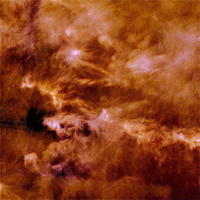
The intricate jumble depicted in this image from ESA’s Herschel space observatory shows the distribution of gas and dust in the Taurus Molecular Cloud, a giant stellar nursery about 450 light-years away in the constellation Taurus, the Bull.

Launched in 2009, Herschel studied the sky at far-infrared wavelengths for almost four years, detecting the glow of cosmic dust in the …

Read the rest of this article

After more than six months of performing scientific research and technology demonstrations in space, three International Space Station crew members are scheduled to depart the orbiting laboratory Thursday, June 11. NASA Television will provide coverage of their station departure and return to Earth.

Coverage begins at 10:40 a.m. EDT Wednesday, June 10, when Expedition 43 Commander Terry Virts of NASA …

Read the rest of this article

Europa

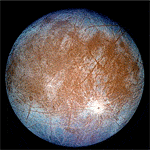
Jupiter’s moon Europa is brimming with water. Although it is thought to be mostly made up of rocky material, the moon is wrapped in a thick layer of water – some frozen to form an icy crust, some potentially pooled in shallow underground lakes or layers of slush, and vast quantities more lurking even deeper still in the form of …

Read the rest of this article

Hubble Space Telescope

Scientists using NASA’s Hubble Space Telescope have discovered that the immense halo of gas enveloping the Andromeda galaxy, our nearest massive galactic neighbor, is about six times larger and 1,000 times more massive than previously measured. The dark, nearly invisible halo stretches about a million light-years from its host galaxy, halfway to our own Milky Way galaxy. This finding promises …

Read the rest of this article

Curtain Eruptions on Enceladus

New research using data from NASA’s Cassini mission suggests most of the eruptions from Saturn’s moon Enceladus might be diffuse curtains rather than discrete jets. Many features that appear to be individual jets of material erupting along the length of prominent fractures in the moon’s south polar region might be phantoms created by an optical illusion, according to the new …

Read the rest of this article

Asteroid Ceres

NASA’s Dawn mission will host the flagship event for its “I C Ceres” space festival at the California Institute of Technology in Pasadena on Saturday, May 9, from 10 a.m. to 4:30 p.m. The free event is intended for all ages.

The first part of the event, an outdoor space expo, will take place at Caltech’s Beckman Auditorium Mall …

Read the rest of this article

Earth Day 2015

Registration is open for a free online course that provides an introduction to monitoring climate change using satellite Earth observation.

ESA has teamed up with FutureLearn, a leading online learning platform, to offer the ‘Monitoring Climate from Space’ course beginning on 8 June.

From their vantage point some 800 km above Earth, satellites provide crucial information on our planet’s land, …

Read the rest of this article