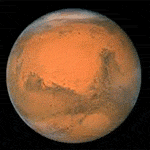
The Planet Mars

NASA’s Curiosity rover is revealing a great deal about Mars, from long-ago processes in its interior to the current interaction between the Martian surface and atmosphere.

Examination of loose rocks, sand and dust has provided new understanding of the local and global processes on Mars. Analysis of observations and measurements by the rover’s science instruments during the first four months …

Read the rest of this article

Insight Mars Mission

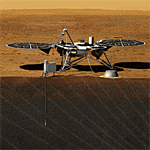
NASA has narrowed to four the number of potential landing sites for the agency’s next mission to the surface of Mars, a 2016 lander to study the planet’s interior.

The stationary Interior Exploration Using Seismic Investigations, Geodesy and Heat Transport (InSight) lander is scheduled to launch in March 2016 and land on Mars six months later. It will touch down …

Read the rest of this article

The Planet Mars

The larger of the two moons of Mars, Phobos, passes directly in front of the other, Deimos, in a new series of sky-watching images from NASA’s Mars rover Curiosity.

Large craters on Phobos are clearly visible in these images from the surface of Mars. No previous images from missions on the surface caught one moon eclipsing the other.

The telephoto-lens …

Read the rest of this article

It’s been almost a year (anniversary is on Aug. 6) since the Curiosity Rover touched down on Mars. In the last year, we’ve seen jaw-dropping full-color panoramas of our closest galactic neighbor, a Martian moonrise, a LEGO Curiosity rover and much, much more thanks to the futuristic expedition

To celebrate a full year of successful Mars exploration, NASA’s JPL released …

Read the rest of this article

Mars

First it was fresh toboggan tracks on Mars, now it’s evidence that it snowed there, albeit a billion years ago.

Rather than water bubbling up from the ground or raining down in drops, a new study based on Hawaiian precipitation patterns supports the idea that the water came down as snow and then melted and ran off to create the …

Read the rest of this article

Glide through part of the largest canyon on Mars, Valles Marineris, in this stunning colour movie from ESA’s Mars Express.

Valles Marineris is not just the largest canyon on Mars, but at 4000 km long, 200 km wide and 10 km deep it is the largest in the entire Solar System.

The movie focuses on an enclosed 8 km-deep trough …

Read the rest of this article

Mars

With the help of rover Curiosity, we now know that ancient Mars had large quantities of liquid water flowing across its surface. However, evidence for large bodies of water — i.e. oceans — has been hard to come by. But using high-resolution orbital data, Caltech scientists now think they’ve found a long-dry river delta that once flowed into a …

Read the rest of this article

Mars

The rover NASA will send to Mars in 2020 should look for signs of past life, collect samples for possible future return to Earth, and demonstrate technology for future human exploration of the Red Planet, according to a report provided to the agency.

The 154-page document was prepared by the Mars 2020 Science Definition Team, which NASA appointed in January …

Read the rest of this article

ExoMars

Hundreds of individual lava flows are seen frozen in time on the flanks of Olympus Mons, the largest volcano in the Solar System.

The images, taken on 21 January 2013 by ESA’s Mars Express, focus on the southeast segment of the giant volcano, which towers some 22 km above the surrounding plains. This is more than double the height of …

Read the rest of this article

Opportunity Mars Rover

When NASA’s Mars rover Opportunity blasted off from Cape Canaveral in 2003, many onlookers expected a relatively short mission. Landing on Mars is risky business. The Red Planet has a long history of destroying spacecraft that attempt to visit it. Even if Opportunity did land safely, it was only designed for a 3-month mission on the hostile Martian surface.

Few, …

Read the rest of this article