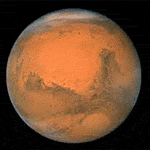
Mars One is an elaborate marketing event, potential reality show, and a probably-unlikely-to-actually-happen mission to Mars starting in 2018 with an unmanned mission to the planet. The plan is to put humans on Mars by 2025. Over 200,000 people applied to be sent on a one-way trip to the Red Planet, and the field has just been narrowed to 1,058 …

Read the rest of this article

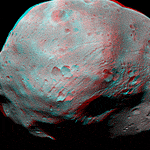
The innermost moon of Mars, Phobos, is seen here in full 360 degree glory. The images were taken by the High Resolution Stereo Camera (HRSC) on ESA’s Mars Express at various times throughout the mission’s 10 years.

The moon’s parallel sets of grooves are perhaps the most striking feature, along with the giant 9 km-wide Stickney impact crater that dominates …

Read the rest of this article

Intriguing mounds of light-toned layered deposits sit inside Juventae Chasma, surrounded by a bed of soft sand and dust.

The origin of the chasma is linked to faulting associated with volcanic activity more than 3 billion years ago, causing the chasma walls to collapse and slump inwards, as seen in the blocky terrain in the right-hand side of this image.…

Read the rest of this article

Mars

NASA’s Mars Reconnaissance Orbiter has revealed to scientists slender dark markings — possibly due to salty water – that advance seasonally down slopes surprisingly close to the Martian equator.

“The equatorial surface region of Mars has been regarded as dry, free of liquid or frozen water, but we may need to rethink that,” said Alfred McEwen of the University of …

Read the rest of this article

NASA’s Curiosity rover is providing vital insight about Mars’ past and current environments that will aid plans for future robotic and human missions.

In a little more than a year on the Red Planet, the mobile Mars Science Laboratory has determined the age of a Martian rock, found evidence the planet could have sustained microbial life, taken the first readings …

Read the rest of this article

Enjoy views of the martian north pole from all angles in this new animation from ESA’s Mars Express.

The ice cap has a diameter of about 1000 km and consists of many thin layers of ice mixed with dust that extend to a depth of around 2 km below the cap. The prominent gap in the ice cap is a …

Read the rest of this article

A NASA mission that will investigate how Mars lost its atmosphere and abundant liquid water launched into space at 1:28 p.m. EST Monday from Cape Canaveral Air Force Station in Florida.

The agency’s Mars Atmosphere and Volatile Evolution (MAVEN) spacecraft separated from an Atlas V Centaur rocket’s second stage 53 minutes after launch. The solar arrays deployed approximately one hour …

Read the rest of this article

The entry, descent and landing demonstrator module that will fly on the 2016 ExoMars mission has been named ‘Schiaparelli’ in honour of the Italian astronomer Giovanni Schiaparelli, who famously mapped the Red Planet’s surface features in the 19th century.

ExoMars is a joint endeavour between ESA and Russia’s Roscosmos space agency, and comprises two missions that will be launched to …

Read the rest of this article

Showcasing Mars

The Planet Mars

From the highest volcano to the deepest canyon, from impact craters to ancient river beds and lava flows, this showcase of images from ESA’s Mars Express takes you on an unforgettable journey across the Red Planet.

Mars Express was launched on 2 June 2003 and arrived at Mars six-and-a-half months later. It has since orbited the planet nearly 12,500 times, …

Read the rest of this article

The Planet Mars

Ripped apart by tectonic forces, Hebes Chasma and its neighbouring network of canyons bear the scars of the Red Planet’s early history.

ESA’s Mars Express has flown over this region of Mars on numerous occasions, but this new eight-image mosaic reveals Hebes Chasma in full and in greater detail than ever.


Location of Hebes Chasma, at about 1°S / 284°E, …

Read the rest of this article