Public Workshop for NASA’s Asteroid Initiative
Watch the NASA TV coverage of the asteroid redirection systems session of the NASA-hosted public workshop at the Lunar and Planetary Institute in Houston to examine…
Read the articleWatch the NASA TV coverage of the asteroid redirection systems session of the NASA-hosted public workshop at the Lunar and Planetary Institute in Houston to examine…
Read the articleNASA has completed the first step toward a mission to find and capture a near-Earth asteroid, redirect it to a stable lunar orbit and send humans…
Read the articlePlanetary Defense Planetary Resources just announced a collaboration with Zooniverse that will empower citizen scientists to aid in the search for potentially hazardous asteroids (PHAs) and…
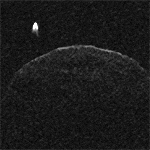
Read the articleScientists working with NASA’s 230-foot-wide (70-meter) Deep Space Network antenna at Goldstone, Calif., have released a new and improved movie clip of near-Earth asteroid 1998 QE2…
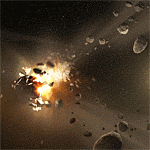
Read the articleThis artist’s conception shows how families of asteroids are created. Over the history of our solar system, catastrophic collisions between asteroids located in the belt between…
Read the articleThe first radar images of asteroid 1998 QE2 were obtained when the asteroid was about 3.75 million miles (6 million kilometers) from Earth. The radar collage…
Read the articleNASA is tracking a large near-Earth asteroid as it passes by the Earth-Moon system on May 31st. Amateur astronomers in the northern hemisphere may be able…
Read the articlePlanetary Resource’s dedication to prospecting asteroids with space telescopes is an interesting opportunity. Today (May 29th, 2013) they’ll be announcing something big that anyone can be…
Read the articleESA today inaugurated a new hub that will strengthen Europe’s contribution to the global hunt for asteroids and other hazardous natural objects that may strike Earth.…
Read the articleOn May 31, 2013, asteroid 1998 QE2 will sail serenely past Earth, getting no closer than about 3.6 million miles (5.8 million kilometers), or about 15…
Read the article