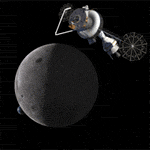
Humans venturing beyond Earth orbit deeper into space face increased exposure to cosmic radiation, so ESA has teamed with Germany’s GSI particle accelerator to test potential shielding for astronauts, including Moon and Mars soil.


NASA proposal for a future deep space station, ‘parked’ at lunar Lagrange point 2 past the far side of the Moon. Residing beyond Earth’s magnetic field, …

Read the rest of this article

ESA’s Herschel space observatory has discovered enough water vapour to fill Earth’s oceans more than 2000 times over, in a gas and dust cloud that is on the verge of collapsing into a new Sun-like star.


Herschel’s infrared view of part of the Taurus Molecular Cloud, within which the bright, cold pre-stellar cloud L1544 can be seen at the lower …

Read the rest of this article

Clouds regularly punctuate Earth’s blue sky, but on Venus the clouds never part, for the planet is wrapped entirely in a 20 km-thick veil of carbon dioxide and sulphuric dioxide haze.

This view shows the cloud tops of Venus as seen in ultraviolet light by the Venus Express spacecraft on 8 December 2011, from a distance of about 30 000 …

Read the rest of this article

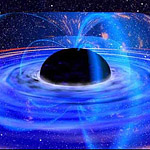
NASA’s Swift satellite recently detected a rising tide of high-energy X-rays from a source toward the center of our Milky Way galaxy. The outburst, produced by a rare X-ray nova, announced the presence of a previously unknown stellar-mass black hole.

“Bright X-ray novae are so rare that they’re essentially once-a-mission events and this is the first one Swift has seen,” …

Read the rest of this article

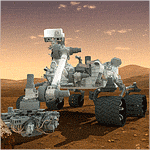
Curiosity Mars Rover

NASA’s Curiosity rover is in a position on Mars where scientists and engineers can begin preparing the rover to take its first scoop of soil for analysis.


NASA’s Mars rover Curiosity cut a wheel scuff mark into a wind-formed ripple at the “Rocknest” site to give researchers a better opportunity to examine the particle-size distribution of the material forming the …

Read the rest of this article

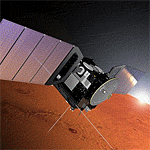
On 8 June, the high-resolution stereo camera on Mars Express captured a region within the 1800 km-wide and 5 km-deep Argyre basin, which was created by a gigantic impact in the planet’s early history.


Click image for larger view. High-Resolution Stereo Camera (HRSC) nadir and colour channel data taken during revolution 10743 on 8 June 2012 by ESA’s Mars Express …

Read the rest of this article

Curiosity Mars Rover

NASA’s Curiosity Mars rover checked in on Mars Wednesday using the mobile application Foursquare. This marks the first check-in on another planet. Users on Foursquare can keep up with Curiosity as the rover checks in at key locations and posts photos and tips, all while exploring the Red Planet.


This artist’s concept features NASA’s Mars Science Laboratory Curiosity rover, a …

Read the rest of this article

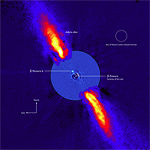
Pristine material that matches comets in our own Solar System have been found in a dust belt around the young star Beta Pictoris by ESA’s Herschel space observatory.


Close-up of olivine crystals seen inside a meteorite found on Earth that originated from a partly melted Solar System asteroid. The yellow olivine crystals are on the order of a few millimetres …

Read the rest of this article

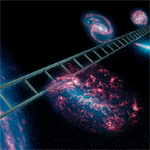
Astronomers using NASA’s Spitzer Space Telescope have announced the most precise measurement yet of the Hubble constant, or the rate at which our universe is stretching apart.


Astronomers using NASA’s Spitzer Space Telescope have greatly improved the cosmic distance ladder used to measure the expansion rate of the universe, as well as its size and age. The cosmic distance ladder, …

Read the rest of this article

Planetary Resources are looking for passionate college students for paid co-op positions to help them mine asteroids this coming spring and summer…

If you love space and want to contribute directly to the development of the next generation of space exploration technologies, they want to hear from you (or from anyone you know that you think would be interested).

Click

Read the rest of this article