AAVSO Alert Notice 474
Multiwavelength Campaign on delta Ori (Mintaka)
December 14, 2012

An international team of astronomers, including Drs. Tony Moffat (University of Montreal), Michael Corcoran (NASA GSFC), and Noel Richardson (University of Montreal), has requested AAVSO photometry and spectroscopy of delta Ori (Mintaka) in support of their multiwavelength campaign on this hot binary star in Orion’s Belt. Satellite …

Read the rest of this article

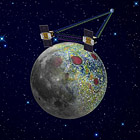
Twin lunar-orbiting NASA spacecraft that have allowed scientists to learn more about the internal structure and composition of the moon are being prepared for their controlled descent and impact on a mountain near the moon’s north pole at about 2:28 p.m. PST (5:28 p.m. EST) Monday, Dec. 17.


Last Flight for GRAIL’s Twin Spacecraft: This still image and animation shows …

Read the rest of this article

NASA

In 2012, NASA continued to implement America’s ambitious space exploration program, landing the most sophisticated rover on the surface of Mars, carrying out the first-ever commercial mission to the International Space Station and advancing the systems needed to send humans deeper into space.

“NASA achieved historic milestones this year landing the most sophisticated rover on the surface of Mars, carrying …

Read the rest of this article

The international Cassini mission has spotted what appears to be a miniature extraterrestrial version of the Nile River: a river valley on Saturn’s moon Titan that stretches more than 400 km from its ‘headwaters’ to a large sea.

It is the first time images have revealed a river system this vast and in such high resolution anywhere beyond Earth.

Scientists …

Read the rest of this article

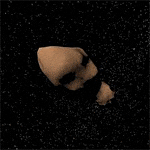
This week, NASA’s Goldstone radar is tracking a large asteroid as it passes by Earth, and obtaining unusually clear images of the tumbling space rock.

“There is no danger of a collision with Earth,” says Lance Benner of NASA’s Near Earth Object Program. “At closest approach on Dec. 12th, asteroid 4179 Toutatis was 7 million km away or 18 times …

Read the rest of this article

Hubble Space Telescope

Using NASA’s Hubble Space Telescope, astronomers announced Dec. 12 they have seen further back in time than ever before and have uncovered a previously unseen population of seven primitive galaxies that formed more than 13 billion years ago, when the universe was less than 3 percent of its present age. The deepest images to date from Hubble yield the first …

Read the rest of this article

If you’re outdoors after sunset this week, be alert for meteors. Not only is the Geminid meteor shower active as Earth passes through a stream of debris from “rock comet” 3200 Phaethon, but also, say forecasters, a new meteor shower could make an appearance.

“The source of the new shower is Comet Wirtanen,” says Bill Cooke of NASA’s Meteoroid Environment …

Read the rest of this article

Using computer simulations, scientists from the NASA Astrobiology Institute team at the University of Hawaii are shedding light on a question that has challenged astronomers for years: What causes wide binary stars?


The widest binaries and triple systems have very elongated orbits, so the stars spend most of their time far apart. But once in every orbital revolution they are …

Read the rest of this article

I met Patrick Moore on several occasions – once at a book signing, and the others when I acted as his chauffeur when the astronomy society I was then involved with brought him over for a lecture and no one else had a car they could lend for transport.

So it was with a great deal of sadness that I …

Read the rest of this article

Every year in mid-December, astronomers look up in the sky and witness a mystery. It announces itself with a flurry of shooting stars. For several nights in a row, dozens to hundreds of meteors per hour cut across the glistening constellations of winter, each one a little puzzle waiting to be solved.


The Geminid meteor shower peaks on Dec. 13th …

Read the rest of this article