Later this year, Comet ISON is expected to become a naked-eye object when it skims through the atmosphere of the sun. The Hubble Space Telescope has just obtained a sneak preview.

Hubble photographed ISON on April 10th. At the time, the comet was 386 million miles from the sun (394 million miles from Earth), just inside the orbit of Jupiter. …

Read the rest of this article

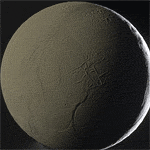
A patchwork network of frozen ridges and troughs cover the face of Enceladus, Saturn’s most enigmatic of icy moons.

This face-on colour view of Enceladus was taken by the international Cassini spacecraft on 31 January 2011, from a distance of 81 000 km, and processed by amateur astronomer Gordan Ugarković.


This face-on colour view of Enceladus was taken by the …

Read the rest of this article

Anticipation is building as Comet ISON plunges into the inner solar system for a close encounter with the sun in November 2013. Blasted at point-blank range by solar radiation, the sungrazer will likely become one of the finest comets in many years.

When NASA’s Swift spacecraft observed the comet in January 2013, it was still near the orbit of Jupiter, …

Read the rest of this article

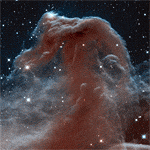
New views of the Horsehead Nebula and its turbulent environment have been unveiled by ESA’s Herschel space observatory and the NASA/ESA Hubble space telescope.


Stunning new view from ESA’s Herschel space observatory of the iconic Horsehead Nebula in the context of its surroundings. The image is a composite of the wavelengths of 70 microns (blue), 160 microns (green) and 250 …

Read the rest of this article

NASA

For hand towels, astronauts get those little vacuum-packed pucks that you kind of have to unravel into a towel. But what happens when you actually put the towels to use?

Two Nova Scotia high school students, Kendra Lemke and Meredith Faulkner, submitted this experiment to Canadian Space Agency and got to see astronaut Chris Hadfield actually test it out on …

Read the rest of this article

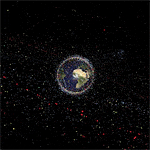
The continuing growth in space debris poses an increasing threat to economically vital orbital regions. Next week, hundreds of top experts from across the globe will meet at Europe’s largest-ever debris forum to share their latest research findings and discuss potential solutions.


All human-made space objects result from the near-5000 launches since the start of the space age. About 65% …

Read the rest of this article

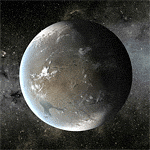
NASA’s Kepler mission has discovered two new planetary systems that include three super-Earth-size planets in the “habitable zone,” the range of distance from a star where the surface temperature of an orbiting planet might be suitable for liquid water.


The artist’s concept depicts Kepler-62f, a super-Earth-size planet in the habitable zone of a star smaller and cooler than the sun, …

Read the rest of this article

Like many of his colleagues at NASA’s Jet Propulsion Laboratory, Pasadena, Calif., Shyam Bhaskaran is working a lot with asteroids these days. And also like many of his colleagues, the deep space navigator devotes a great deal of time to crafting, and contemplating, computer-generated 3-D models of these intriguing nomads of the solar system.


This spectacular image of comet Tempel …

Read the rest of this article

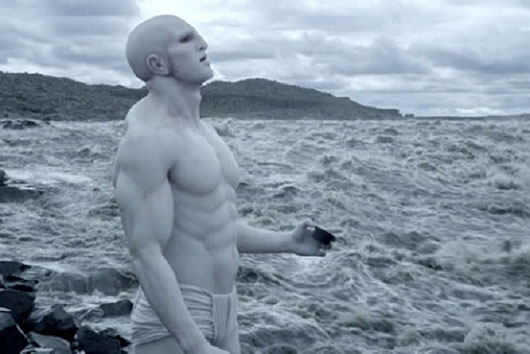
Applying a maxim from computer science to biology raises the intriguing possibility that life existed before Earth did and may have originated outside our solar system, scientists say.


In the science fiction movie Prometheus (2012), the building blocks of life were provided by a proto-human species from another planet.
Image credit: Prometheus (2012) from Twentieth Century Fox

Moore’s Law is …

Read the rest of this article

ESA’s Herschel space observatory has discovered an extremely distant galaxy making stars more than 2000 times faster than our own Milky Way. Seen at a time when the Universe was less than a billion years old, its mere existence challenges our theories of galaxy evolution.


Artist’s impression of starburst galaxy HFLS3. The galaxy appears as little more than a faint, …

Read the rest of this article