Astronomers using ESA’s Herschel space observatory to probe the turbulent beginnings of a Sun-like star have found evidence of mighty stellar winds that could solve a puzzling meteorite mystery in our own back yard.

In spite of their tranquil appearance in the night sky, stars are scorching furnaces that spring to life through tumultuous processes – and our 4.5 billion-year-old …

Read the rest of this article

Astronomers using ESA and NASA high-energy observatories have discovered a tantalising clue that hints at an elusive ingredient of our Universe: dark matter.

Although thought to be invisible, neither emitting nor absorbing light, dark matter can be detected through its gravitational influence on the movements and appearance of other objects in the Universe, such as stars or galaxies.

Based on …

Read the rest of this article

Faced with the challenge of capturing tumbling satellites to clear key orbits, ESA is considering turning to an ancient terrestrial technology: the harpoon.

Used since the Stone Age, first to spear fish and later to catch whales, the humble harpoon is being looked at for snagging derelict space hardware.

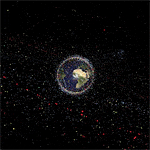
Decades of launches have left Earth surrounded by a halo of …

Read the rest of this article

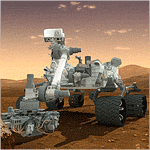
Curiosity Mars Rover

NASA’s Mars Curiosity rover will complete a Martian year — 687 Earth days — on June 24, having accomplished the mission’s main goal of determining whether Mars once offered environmental conditions favorable for microbial life.

One of Curiosity’s first major findings after landing on the Red Planet in August 2012 was an ancient riverbed at its landing site. Nearby, at …

Read the rest of this article

Just as children are sorted into age groups at school, so the seeds of new stars can also be found in ‘classes’ of others of similar ages. This is especially true when the birth of stars in a cloud of gas and dust is triggered by an external event, like the explosion of a nearby supernova.

This image from ESA’s …

Read the rest of this article

Three weeks into ESA astronaut Alexander Gerst’s Blue Dot mission on the International Space Station and the new arrival is now spending more time on scientific research in the microgravity laboratory.


Europe’s laboratory on the International Space Station. Since 2008 the module has offered a unique workstation for researchers to investigate phenomenon in microgravity. Over 110 ESA-led experiments involving some …

Read the rest of this article

Astronomers using NASA’s Spitzer Space Telescope have measured the size of an asteroid candidate for NASA’s Asteroid Redirect Mission (ARM), a proposed spacecraft concept to capture either a small asteroid, or a boulder from an asteroid. The near-Earth asteroid, called 2011 MD, was found to be roughly 20 feet (6 meters) in size, and its structure appears to contain a …

Read the rest of this article

NASA is on the hunt for an asteroid to capture with a robotic spacecraft, redirect to a stable orbit around the moon, and send astronauts to study in the 2020s — all on the agency’s human Path to Mars. Agency officials announced on Thursday, June 19, recent progress to identify candidate asteroids for its Asteroid Redirect Mission (ARM), increase public …

Read the rest of this article

Hubble Space Telescope

They may be little, but they pack a big star-forming punch. New observations from NASA’s Hubble Space Telescope show small galaxies, also known as dwarf galaxies, are responsible for forming a large proportion of the universe’s stars.

Studying this early epoch of the universe’s history is critical to fully understanding how these stars formed and how galaxies grew and evolved …

Read the rest of this article

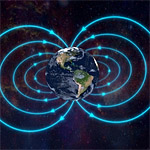
The first set of high-resolution results from ESA’s three-satellite Swarm constellation reveals the most recent changes in the magnetic field that protects our planet.

Launched in November 2013, Swarm is providing unprecedented insights into the complex workings of Earth’s magnetic field, which safeguards us from the bombarding cosmic radiation and charged particles.


‘Snapshot’ of the main magnetic field at Earth’s …

Read the rest of this article