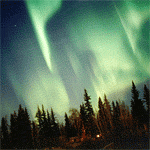
Auroras are the most visible manifestation of the Sun’s effect on Earth, but many aspects of these spectacular displays are still poorly understood. Thanks to ESA’s Cluster and NASA’s Image satellites working together, a particular type of very high-latitude aurora has now been explained.

Although separated by some 150 million kilometres, the Sun and Earth are connected by the solar …

Read the rest of this article

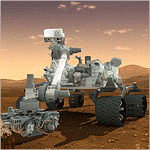
Curiosity Mars Rover

NASA’s Mars Curiosity rover has measured a tenfold spike in methane, an organic chemical, in the atmosphere around it and detected other organic molecules in a rock-powder sample collected by the robotic laboratory’s drill.

This temporary increase in methane — sharply up and then back down — tells us there must be some relatively localized source,” said Sushil …

Read the rest of this article

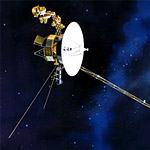
Since 2012, NASA’s Voyager 1 spacecraft has experienced three ‘tsunami waves’ in interstellar space. The most recent, which reached the spacecraft earlier this year, is still propagating outward according to new data. It is the longest-lasting shock wave that researchers have seen in interstellar space.

Most people would have thought the interstellar medium would have been smooth and quiet.

Read the rest of this article

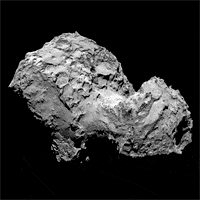
Where did our planet get its oceans? Among planetary scientists, this is one of the most important and perplexing questions about the origins of Earth.

One popular theory holds that water was brought to Earth by the ancient impacts of comets and asteroids. However, new data from the European Space Agency’s Rosetta spacecraft indicate that terrestrial water did not come …

Read the rest of this article

Scientists have calculated that the 2014 UR116 asteroid will fly in dangerous proximity to Earth every three years. If it collides with the planet the energy of the explosion could be a thousand times greater than the impact of the Chelyabinsk meteorite.

Vladimir Lipunov, a leading scientist on the team which discovered the asteroid this October, says the scientists now …

Read the rest of this article

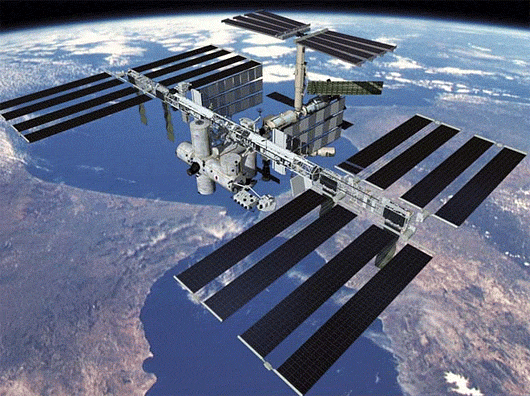
ESA’s fifth and last Automated Transfer Vehicle tested a new technique before docking with the International Space Station in August, at the same time revealing the orbital complex in a new light.

ATV Georges Lemaître demonstrated a set of European sensors that offers future improvements on the autonomous rendezvous and docking that these ferries have completed five times since 2008. …

Read the rest of this article

This Cassini image shows Jupiter from an unusual perspective. If you were to float just beneath the giant planet and look directly up, you would be greeted with this striking sight: red, bronze and white bands encircling a hazy south pole. The multicoloured concentric layers are broken in places by prominent weather systems such as Jupiter’s famous Great Red Spot, …

Read the rest of this article

Mars

Observations by NASA’s Curiosity Rover indicate Mars’ Mount Sharp was built by sediments deposited in a large lake bed over tens of millions of years.

This interpretation of Curiosity’s finds in Gale Crater suggests ancient Mars maintained a climate that could have produced long-lasting lakes at many locations on the Red Planet.

“If our hypothesis for Mount Sharp holds up, …

Read the rest of this article

New Horizons Pluto Flyby

After a voyage of nearly nine years and three billion miles —the farthest any space mission has ever traveled to reach its primary target – NASA’s New Horizons spacecraft came out of hibernation on Dec. 6th for its long-awaited 2015 encounter with the Pluto system.

Operators at the Johns Hopkins University Applied Physics Laboratory in Laurel, Md., confirmed at 9:53 …

Read the rest of this article

AAVSO AAVSO Alert Notice 506
Alpha Com eclipse observing campaign
December 5, 2014

Drs. Matthew W. Muterspaugh and Gregory W. Henry (Tennessee State University) have requested AAVSO observers’ assistance in monitoring the possible Algol-like binary star alpha Com before, during, and after the eclipse they have predicted for mid-to-late January 2015.

The PIs will be using the Fairborn Observatory automated photometric …

Read the rest of this article