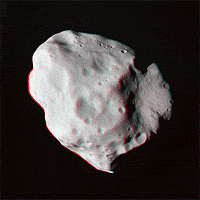
Comet Hitchhiker

Catching a ride from one solar system body to another isn’t easy. You have to figure out how to land your spacecraft safely and then get it on its way to the next destination. The landing part is especially tricky for asteroids and comets, which have low gravitational pull.

A concept called Comet Hitchhiker, developed at NASA’s Jet Propulsion Laboratory, …

Read the rest of this article

The Topography of Ceres

Colorful new maps of Ceres, based on data from NASA’s Dawn spacecraft, showcase a diverse topography, with height differences between crater bottoms and mountain peaks as great as 9 miles (15 kilometers).

Scientists continue to analyze the latest data from Dawn as the spacecraft makes its way to its third mapping orbit.

“The craters we find on Ceres, in terms …

Read the rest of this article

Asteroid Ceres

The closer we get to Ceres, the more intriguing the distant dwarf planet becomes. New images of Ceres from NASA’s Dawn spacecraft provide more clues about its mysterious bright spots, and also reveal a pyramid-shaped peak towering over a relatively flat landscape.

“The surface of Ceres has revealed many interesting and unique features. For example, icy moons in the outer …

Read the rest of this article

Asteroid Ceres

NASA’s Dawn mission will host the flagship event for its “I C Ceres” space festival at the California Institute of Technology in Pasadena on Saturday, May 9, from 10 a.m. to 4:30 p.m. The free event is intended for all ages.

The first part of the event, an outdoor space expo, will take place at Caltech’s Beckman Auditorium Mall …

Read the rest of this article

Asteroid Ceres

NASA’s Dawn spacecraft has become the first mission to achieve orbit around a dwarf planet. The spacecraft was approximately 38,000 miles (61,000) kilometers from Ceres when it was captured by the dwarf planet’s gravity at about 4:39 a.m. PST (7:39 a.m. EST) Friday.

Mission controllers at NASA’s Jet Propulsion Laboratory (JPL) in Pasadena, California received a signal from the spacecraft …

Read the rest of this article

Asteroid Ceres

Dwarf planet Ceres continues to puzzle scientists as NASA’s Dawn spacecraft gets closer to being captured into orbit around the object. The latest images from Dawn, taken nearly 29,000 miles (46,000 kilometers) from Ceres, reveal that a bright spot that stands out in previous images lies close to yet another bright area.

“Ceres’ bright spot can now be seen to …

Read the rest of this article

Asteroid Ceres

NASA’s Dawn spacecraft, on approach to dwarf planet Ceres, has acquired its latest and closest-yet snapshot of this mysterious world. The image of Ceres, taken on Feb. 4, 2015, from a distance of about 90,000 miles (145,000 kilometers), is available at:

http://www.jpl.nasa.gov/spaceimages/details.php?id=pia19174
http://www.jpl.nasa.gov/spaceimages/details.php?id=pia19179

At a resolution of 8.5 miles (14 kilometers) per pixel, the pictures represent the sharpest images to …

Read the rest of this article

Asteroid Ceres

As NASA’s Dawn spacecraft closes in on Ceres, new images show the dwarf planet at 27 pixels across, about three times better than the calibration images taken in early December. These are the first in a series of images that will be taken for navigation purposes during the approach to Ceres.

Over the next several weeks, Dawn will deliver increasingly …

Read the rest of this article

An asteroid, designated 2004 BL86, will safely pass about three times the distance of Earth to the moon on January 26. From its reflected brightness, astronomers estimate that the asteroid is about a third of a mile (0.5 kilometers) in size. The flyby of 2004 BL86 will be the closest by any known space rock this large until asteroid 1999 …

Read the rest of this article

Scientists have calculated that the 2014 UR116 asteroid will fly in dangerous proximity to Earth every three years. If it collides with the planet the energy of the explosion could be a thousand times greater than the impact of the Chelyabinsk meteorite.

Vladimir Lipunov, a leading scientist on the team which discovered the asteroid this October, says the scientists now …

Read the rest of this article