This mosaic, which features the spectacular Kasei Valles, comprises 67 images taken with the High Resolution Stereo Camera on ESA’s Mars Express. The mosaic spans 987 km north–south (19–36°N) and 1550 km east–west (280–310°E). Image Credit:ESA/DLR/FU Berlin (G. Neukum)

Dramatic flood events carved this impressive channel system on Mars covering 1.55 million square kilometres, shown here in a stunning new …

Read the rest of this article


NASA’s Cassini spacecraft looks toward the night side of Saturn’s largest moon and sees sunlight scattering through the periphery of Titan’s atmosphere and forming a ring of color. Image credit: NASA/JPL-Caltech/Space Science Institute

Scientists working with data from NASA’s Cassini mission have confirmed the presence of a population of complex hydrocarbons in the upper atmosphere of Saturn’s largest moon, Titan, …

Read the rest of this article

Curiosity Mars Rover


The Chemistry and Camera (ChemCam) instrument on NASA’s Mars rover Curiosity was used to check the composition of gray tailings from the hole in rock target “Cumberland” that the rover drilled on May 19, 2013. This image taken by the rover’s Mast Camera during the mission’s 281st Martian day, or sol, (May 21, 2013) shows a row of small pits

Read the rest of this article


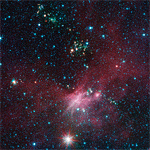
Dozens of newborn stars sprouting jets from their dusty cocoons have been spotted in images from NASA’s Spitzer Space Telescope.

New views from NASA’s Spitzer Space Telescope show blooming stars in our Milky Way galaxy’s more barren territories, far from its crowded core.

The images are part of the Galactic Legacy Infrared Mid-Plane Survey Extraordinaire (Glimpse 360) project, which is …

Read the rest of this article


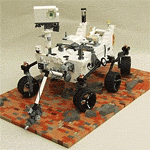
Tim Goddard used Lego to masterfully recreate NASA’s Curiosity rover.

NASA and the LEGO Group are partnering to inspire the next generation of aerospace engineers by offering a new design competition. The competition will spur students of all ages to use the toy bricks in building models of future airplanes and spacecraft.

The “NASA’s Missions: Imagine and Build” …

Read the rest of this article

The Sun

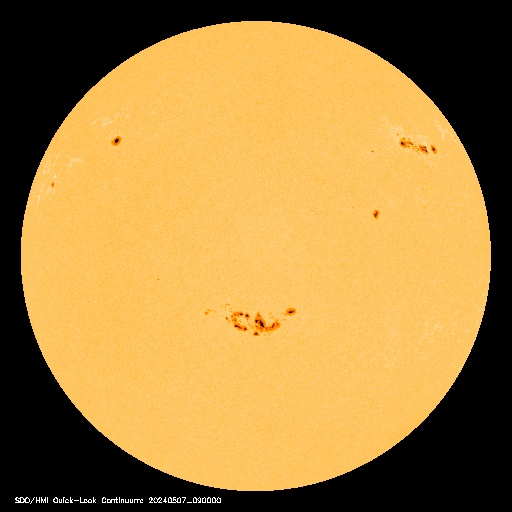
NASA’s next scientific satellite, which is scheduled for launch June 26, will provide the most detailed look ever at the sun’s lower atmosphere or interface region.

The Interface Region Imaging Spectrograph (IRIS) mission will observe how solar material moves, gathers energy, and heats up as it travels through this largely unexplored region of the solar atmosphere. The interface region, located …

Read the rest of this article

AAVSO AAVSO Alert Notice 484
Nova Sco 2013 = PNV J17335943-3606216
June 4, 2013

Event: Nova Sco 2013 = PNV J17335943-3606216

Discovered by: Koichi Nishiyama (Kurume, Japan) and Fujio Kabashima
(Miyaki, Japan)

Discovery Magnitude: unfiltered CCD magnitude 11.1, from two 40-s unfiltered CCD frames, using a 105-mm f/4 camera lens (+SBIG STL6303E camera).

Discovery date: 2013 June 03.6146 UT

Coordinates: R.A. …

Read the rest of this article

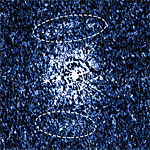
A flash of light from a stellar outburst has been used to probe for the first time the 3-D structure of material ejected by an erupting nova.

Astronomers used NASA’s Hubble Space Telescope to observe the light emitted by the close double-star system T Pyxidis, or T Pyx, a recurrent nova, during its latest outburst in April 2011. Contrary to …

Read the rest of this article