Opportunity Mars Rover


The pale rock in the upper center of this image, about the size of a human forearm, includes a target called “Esperance,” which was inspected by NASA’s Mars Exploration Rover Opportunity. Data from the rover’s alpha particle X-ray spectrometer (APXS) indicate that Esperance’s composition is higher in aluminum and silica, and lower in calcium and iron, than other rocks Opportunity

Read the rest of this article

On May 31, 2013, asteroid 1998 QE2 will sail serenely past Earth, getting no closer than about 3.6 million miles (5.8 million kilometers), or about 15 times the distance between Earth and the moon. And while QE2 is not of much interest to those astronomers and scientists on the lookout for hazardous asteroids, it is of interest to those who …

Read the rest of this article

The Sun

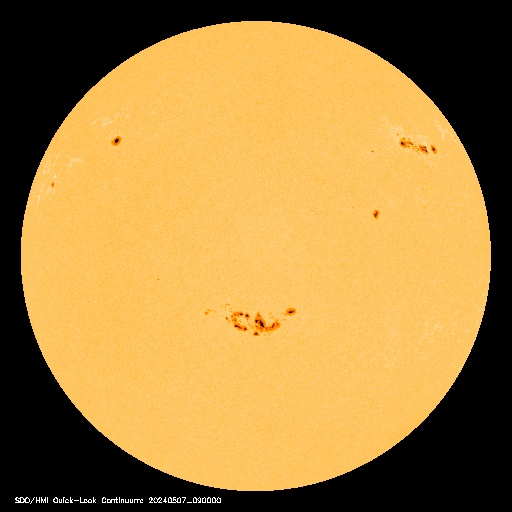
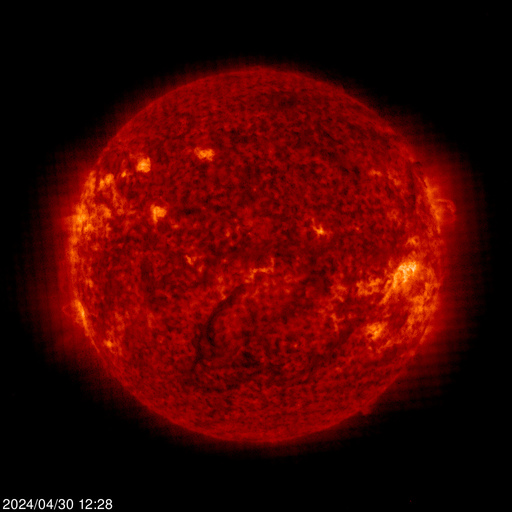
During a 24 hour period straddling May 13th and 14th, the sun unleashed three X-class solar flares. These are the strongest flares of the year so far, and they signal a significant increase in solar activity. The source of the flares, a large sunspot on the sun’s eastern limb, appears poised to erupt again as it turns toward Earth.

NOAA …

Read the rest of this article


These polar maps show the first global, topographic mapping of Saturn’s moon Titan, using data from NASA’s Cassini mission. To create these maps, scientists employed a mathematical process called splining, which uses smooth curved surfaces to “join” the areas between grids of existing topography profiles obtained by Cassini’s radar instrument.Image credit: NASA/JPL-Caltech/ASI/JHUAPL/Cornell/Weizmann

Scientists have created the first global topographic map …

Read the rest of this article

Bright arcs are smeared around the heart of galaxy cluster Abell S1077 in this image taken by the NASA/ESA Hubble space telescope. The arcs are stretched images of distant galaxies distorted by the cluster’s enormous gravitational field.

Galaxy clusters are large groupings of galaxies, each hosting millions of stars. They are the largest existing structures in the Universe, bound by …

Read the rest of this article

NASA’s Hubble Space Telescope has found the building blocks for Earth-sized planets in an unlikely place– the atmospheres of a pair of burned-out stars called white dwarfs.

These dead stars are located 150 light-years from Earth in a relatively young star cluster, Hyades, in the constellation Taurus. The star cluster is only 625 million years old. The white dwarfs are …

Read the rest of this article

In February, a speeding asteroid slammed into our atmosphere and exploded high over Russia’s Ural region, injuring hundreds and causing millions of euros of damage. What should we do if we have a similar – or even bigger – strike in the future?

Of the more than 600,000 known asteroids in our Solar System, almost 10,000 are classified as near-Earth …

Read the rest of this article