During a chance encounter with an unusually strong blast of solar wind arriving at Saturn, the international Cassini spacecraft detected particles being accelerated to ultra-high energies, similar to the acceleration that takes place around supernova explosions.


The international Cassini spacecraft exploring the magnetic environment of Saturn. The image is not to scale. Saturn’s magnetosphere is depicted in grey, while the …
Read the rest of this article

A space rock a few metres across exploded in Earth’s atmosphere above the city of Chelyabinsk, Russia today at about 03:15 GMT. The numerous injuries and significant damage remind us that what happens in space can affect us all. At least 950 people were injured as the shockwave blew out windows and rocked buildings. Most of those hurt, in the …

Read the rest of this article

NASA

NASA Television will provide commentary starting at 2 p.m. EST (11 a.m. PST / 7 p.m. UTC) on Friday, Feb. 15, during the close, but safe, flyby of a small near-Earth asteroid named 2012 DA14. NASA places a high priority on tracking asteroids and protecting our home planet from them. This flyby will provide a unique opportunity for researchers to …

Read the rest of this article

Do you want to contribute to the study of the cosmos, but don’t have an astronomy degree or even a telescope? Well, here’s a solution for you. Use your free time and your computer to analyze real data from Hubble and other space telescopes. Visit HubbleSite’s new citizen science portal to find active astronomy projects that you can get involved …

Read the rest of this article

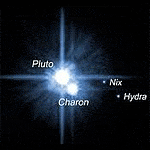
Pluto and Charon

Pluto may have been demoted, but its family is getting bigger and bigger. Now, two of the dwarf planet’s tiniest moons need names — but rather than leaving the Plutonian satellites’ naming ceremony to astronomers, that honor has fallen to you.


The Plutonian system detailing the orbits of Charon, Nix, Hydra, “P4″ and “P5.” Image credit: NASA

The discoverers of …

Read the rest of this article

Since Europe’s Columbus laboratory module was attached to the International Space Station five years ago, it has offered researchers worldwide the opportunity to conduct science beyond the effects of gravity.

A total of 110 ESA-led experiments involving some 500 scientists have been conducted since 2008, spanning fluid physics, material sciences, radiation physics, the Sun, the human body, biology and astrobiology. …

Read the rest of this article

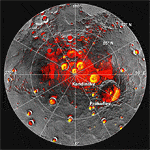
NASA has recently discovered a very strange planet. Its days are twice as long as its years. It has a tail like a comet. It is hot enough to melt lead, yet capped by deposits of ice. And to top it all off … it appears to be pink.

The planet is Mercury.

Of course, astronomers have known about Mercury …

Read the rest of this article

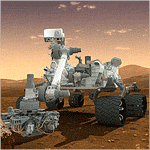
Curiosity Mars Rover

NASA’s Curiosity rover has, for the first time, used a drill carried at the end of its robotic arm to bore into a flat, veiny rock on Mars and collect a sample from its interior. This is the first time any robot has drilled into a rock to collect a sample on Mars.


At the center of this image from …

Read the rest of this article

NASA

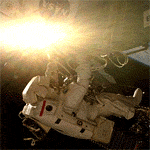
NASA will host its first Google+ Hangout live with the International Space Station from 11 a.m. to noon EST, Friday, Feb. 22. This event will connect NASA’s social media followers with astronauts on the ground and living and working aboard the laboratory orbiting 240 miles above Earth.

Google+ Hangouts allow as many as 10 people to chat face-to-face, while thousands …

Read the rest of this article

Two of NASA’s Great Observatories, the Spitzer and Hubble space telescopes, have teamed up to uncover a mysterious infant star that behaves like a police strobe light.


NASA’s Spitzer and Hubble space telescopes have teamed up to uncover a mysterious infant star that behaves like a police strobe light. Image credit: NASA, ESA, J. Muzerolle (STScI), E. Furlan (NOAO and …

Read the rest of this article