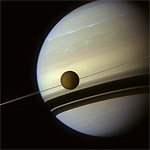
Saturn and Titan

Call it a Saturnian version of the Ouroboros, the mythical serpent that bites its own tail. In a new paper that provides the most detail yet about the life and death of a monstrous thunder-and-lightning storm on Saturn, scientists from NASA’s Cassini mission describe how the massive storm churned around the planet until it encountered its own tail and sputtered …

Read the rest of this article
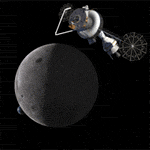
Setting up a lunar base could be made much simpler by using a 3D printer to build it from local materials. Industrial partners including renowned architects Foster + Partners have joined with ESA to test the feasibility of 3D printing using lunar soil.

“Terrestrial 3D printing technology has produced entire structures,” said Laurent Pambaguian, heading the project for ESA.

“Our …

Read the rest of this article

A star thought to have passed the age at which it can form planets may, in fact, be creating new worlds. The disk of material surrounding the surprising star called TW Hydrae may be massive enough to make even more planets than we have in our own solar system.


This artist’s concept illustrates an icy planet-forming disk around a young …

Read the rest of this article

ESA’s Venus Express has made unique observations of Venus during a period of reduced solar wind pressure, discovering that the planet’s ionosphere balloons out like a comet’s tail on its nightside.


The change in ionosphere of Venus during normal solar wind conditions (left) and reduced solar wind activity (right), as observed by ESA’s Venus Express spacecraft in August 2010. The …

Read the rest of this article

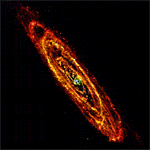
In this new view of the Andromeda galaxy from ESA’s Herschel space observatory, cool lanes of forming stars are revealed in the finest detail yet.

Andromeda, also known as M31, is the nearest major galaxy to our own Milky Way at a distance of 2.5 million light-years, making it an ideal natural laboratory to study star formation and galaxy evolution.…

Read the rest of this article

Mars

In this 6th session of the internet-based live lectures between Universities and Institutes, Dr Jorge Vago (ESA) discusses missions to Mars and in particular the European mission ExoMars.

ExoMars’s scientific objectives are:

1) To search for signs of past and present life;

2) To identify surface hazards to future human Mars missions; and

3) To characterise, in the shallow subsurface, …

Read the rest of this article

This is a press release from Chris Lewicki, the President and Chief Asteroid Miner at Planetary Resources:

In the accompanying video, you can see one of our full scale Arkyd-100 mechanical prototypes.  The Arkyd-100 is our space telescope and technology demonstrator for our Arkyd Series prospecting missions.

One of the earliest decisions we made was to design and build …

Read the rest of this article

The European Space Agency wanted to know the level of knowledge about the number of planets in our Solar System so they asked people around Europe. It’s not very encouraging…

Read the rest of this article

Bright and dark cloud bands wind around the poles of Venus in this beautiful sequence tracked by ESA’s Venus Express as it makes a rollercoaster orbit around the planet.

We join the spacecraft from a staggering 66,000 km above the south pole, staring down into the swirling south polar vortex. From this bird’s-eye view, half of the planet is in …

Read the rest of this article

Mars


This view of layered rocks on the floor of McLaughlin Crater shows sedimentary rocks that contain spectroscopic evidence for minerals formed through interaction with water. The High Resolution Imaging Science Experiment (HiRISE) camera on NASA’s Mars Reconnaissance Orbiter recorded the image. A combination of clues suggests this 1.4-mile-deep (2.2-kilometer-deep) crater once held a lake fed by groundwater. Part of the …

Read the rest of this article